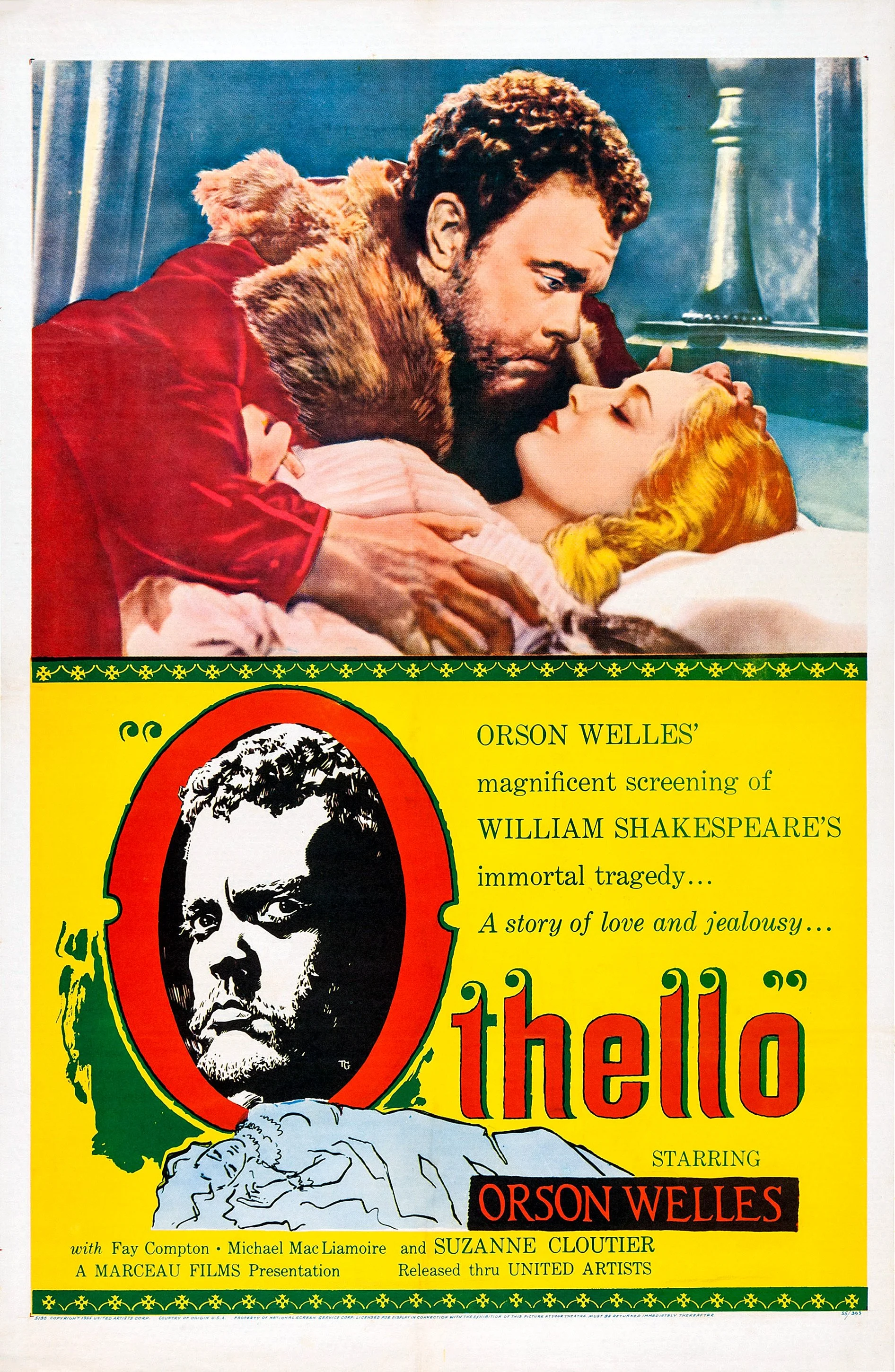
Director: Orson Welles
Cast: Orson Welles, Micheál Mac Liammóir, Suzanne Cloutier, Robert Coote
Have I Seen it Before: Sure. I’ve been making jokes about Welles miscasting himself as the tragic Moor for years.
Did I Like It: Surprisingly, Welles only directed three Shakespeare feature adaptations for the screen, and it’s unfortunate that this is the weakest of the trilogy. It is not as clever, fully-formed, or expansive in scope as Chimes at Midnight (1965), nor is it as minimalistic and fully necessary energy as his Macbeth (1948).
The film has all the singular Welles cinematic trademarks. The camera never quite does what one might expect it to, characters talk over each other at a time where sound was treated so insanely delicately that to depict people in the way they might actually speak might tax the technology, and the film ultimately feels unfinished.
I don’t mean to introduce that word “unfinished” as a derogatory. Welles’ film career was so thoroughly cobbled together, that I can’t help but keep my eyes glued to one of his movies as it unfurls. There’s always a measure of panic that any of his films—aside from Citizen Kane (1941) and perhaps Touch of Evil (1958)—will complete unravel before the end credits. As films are hardly ever projected via film any more, his may be the only films where that experience can be beheld in all its glory anymore.
And then there’s that casting problem. It cannot be avoided, and I have a hard time believing it was accepted with any degree of widespread enthusiasm at the time of its release. Then, there might have been any number of men of color who could have brought the Moor to vibrant life for Welles’ camera, but instead Welles’ ego (I can’t imagine it was for the sake of the film’s commercial prospect) prevailed and he both directs and stars in the picture. Then, it feels like the wrong actor in the wrong role (he would have been glorious as Iago—here played by Liammóir), and now it’s just another example of where a modern audience has to parse out just exactly where lies the border between swarthy-face and outright blackface, or more importantly whether thats a distinction without a difference.