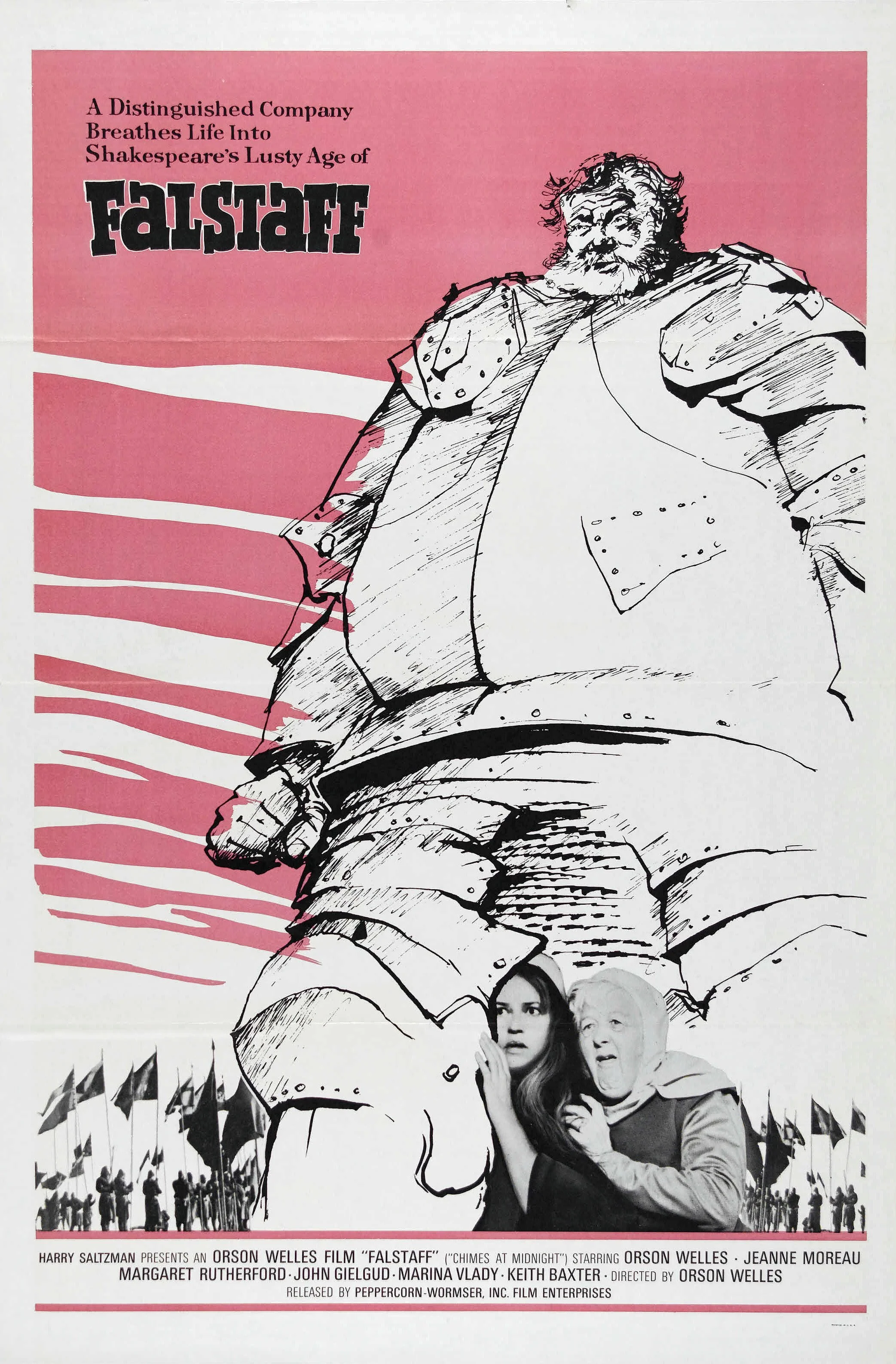
Director: Orson Welles
Cast: Orson Welles, Jeanne Moreau, Margaret Rutherford, John Gielgud
Have I Seen it Before: Never. As I type this, this is the last of the films directed by Welles that I’m catching. I know. I’m unforgivably late to a party I myself was largely throwing.
Did I Like It: Welles struggled mightily to bring cinematic vitality to the works of the Bard, sometimes succeeding wildly, (Macbeth (1948)) and sometimes not accomplishing all of his goals as well as the audience might hope (Othello (1951); your mileage may vary). Here, to play Flastaff—through all his adventures in the Shakespeare Cinematic Universe—was his lifelong ambition. Where as the Moor he was tragically, unavoidably miscast, here it not only seemed as if Welles always wanted to play Shakespeare’s great fool, his entire life may have been orchestrated to give him the opportunity.
The film’s virtues do not stop there. I’ve never thought of Welles as an action director in any sense of the word, but the Battle of Shrewsbury might feel as if it is both too disjointed and goes on too long for the sake of a modern audience, but I would push back against that myopic conclusion. The battle feels real and not some sort of pop culture confection. Film audiences would have likely forgiven Welles for sticking to the stentorian speechmaking, or for succumbing to a bubble gum aesthetic during this sequence, but if there was one thing that Welles ensured he did in his films—even after he was cobbling them together with no resources to speak of—it was to consistently punish those who come to his films with any preconceptions of how a film ought to behave.
Another element that I couldn’t help be struck by: the cinema—at least, the cinema as wielded by Welles—can capture more resolutely the banal tragedy of death better than the stage could ever hope to. His Macbeth and Othello have it as well, but here it is all the more potent. The tale of Falstaff isn’t necessarily meant to be a tragedy, necessarily. But after all the king-making and merry wive-ing is over, he is merely a wooden casket slowly being taken away by horse cart. All people, Welles included*, are heading to such an anticlimactic fate.
*But what this book presupposes is…