Party Now, Apocalypse Later Industries

Where creativity went when it said it was going out for cigarettes.
  • Home
  • BOOKS
    • THE ONCE AND FUTURE ORSON WELLES
    • IF ANY OF THESE STORIES GOES OVER 1000 WORDS...
    • ORSON WELLES OF MARS
    • THE DEVIL LIVES IN BEVERLY HILLS
    • A LOSS FOR NORMALCY
    • RIGHT - A NOVEL OF POLITICS
  • PODCASTS
    • Beyond the Cabin in the Woods
    • THE HOLODECK IS BROKEN
    • THE FOURTH WALL
    • As The Myth Turns
    • FRIENDIBALS! - TWO FRIENDS TALKING ABOUT HANNIBAL LECTER
    • DISORGANIZED! A Criminal Minds Podcast
  • MOVIE REVIEWS
  • BLOGS AND MORE
    • Bloggy B Bloggington III, DDS
    • THE HOLODECK IS BROKEN BLOG
    • REALLY GOOD MAN!
  • Home
    • THE ONCE AND FUTURE ORSON WELLES
    • IF ANY OF THESE STORIES GOES OVER 1000 WORDS...
    • ORSON WELLES OF MARS
    • THE DEVIL LIVES IN BEVERLY HILLS
    • A LOSS FOR NORMALCY
    • RIGHT - A NOVEL OF POLITICS
    • Beyond the Cabin in the Woods
    • THE HOLODECK IS BROKEN
    • THE FOURTH WALL
    • As The Myth Turns
    • FRIENDIBALS! - TWO FRIENDS TALKING ABOUT HANNIBAL LECTER
    • DISORGANIZED! A Criminal Minds Podcast
  • MOVIE REVIEWS
    • Bloggy B Bloggington III, DDS
    • THE HOLODECK IS BROKEN BLOG
    • REALLY GOOD MAN!

A Blog About Watching Movies (AKA a Blog in Search of a Better Title)

220px-Poster_for_the_1960_film_The_Time_Machine.jpg

The Time Machine (1960)

Mac Boyle August 5, 2020

Director: George Pal

Cast: Rod Taylor, Alan Young, Yvette Mimieux, Sebastian Cabot

Have I Seen It Before?: Here’s a deep, dark secret to start off this review. If I have any sort of reputation in this world, it’s as some manner of student of time travel. I’ve written about it ad infinitum, I’ve talked about it, and several are under the assumption that I’ve lived it. When it comes to H.G. Wells’ classic tale, I’ve read it a number of times in various editions, count Time After Time (1979) as one of my favorite films of all time, and have even written a sequel to the adventures of The Time Traveller.

And yet, somehow, no. I’ve never gotten around to seeing this one.

Did I like it?: That’s where the true tragedy of me somehow avoiding this film really comes in. I never got around to this one for no other reason than I always thought it would be too camp, or too geared for children to play to my taste. I’m not sure why I allowed that thinking to stop me, if for no other reason than “too geared for children” or “too campy” is pretty precisely my aesthetic.

Also, the film works. It is visually interesting, with the special effects work in the film rightly garnering an Academy Award, and still largely holding up sixty years later, minus a monorail or two. It goes through all of the beats of the classic story, including the breaking down of the fourth dimension, which inexplicably remains my favorite section of the book. It also does so at a lively pace and offering enough imaginative exploration into the anxieties and fears of the mid-twentieth century, just as much as the novel ruminated on the anxieties of the late nineteenth. There’s really not much more one can expect from an adaptation of the Wells book, or really any time travel story.

Tags the time machine (1960), george pal, rod taylor, alan young, yvette mimieux, sebastian cabot, time travel movies
Comment
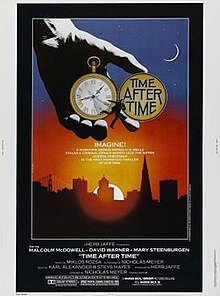
220px-TimeAfterTime79.jpg

Time After Time (1979)

Mac Boyle May 24, 2020

Director: Nicholas Meyer

Cast: Malcolm McDowell, David Warner, Mary Steenburgen, Charles Cioffi

Have I Seen It Before?: Many, many times.

Did I like it?: It’s a solid bet that I’m going to be effusive about anything even tangentially related to Nicholas Meyer, the director of a solid candidate for my favorite film of all time, Star Trek II: The Wrath of Khan (1982). I have a certain soft spot for Volunteers (1985), and I even find some charm in Company Business (1991), even though Meyer largely disowns the film, and I have a hard time getting through it in one sitting.

But this movie is one for the books. As a zealot of the time travel genre, this is in my personal pantheon. I love it without question. I love it so much that I had no choice but to watch the abortive attempt to make a television series out of the concept several years ago. If I ever make something half as good as this movie, my time in creative endeavors will be well-spent.

And it’s odd, even for the year in which it was released, it has a certain antiquated feel. It has far more in common with a film like The Time Machine (1960) than later films like Back to the Future (1985). It even influenced later films, influencing the casting of Back to the Future Part III (1990) and meriting a reference along with other entries of the genre in Avengers: Endgame (2019).

The films strengths rest in the writing and performances. Meyer is physically unable to produce a script that isn’t thoroughly literate. The film ebbs and flows on the philosophies of H.G. Wells, which is only made more ironic when one considers that with his utopian ideals and gentlemanly manor, he is the idealized Star Trek hero in the Gene Roddenberry mold at the center of a film made by a man who tried to revitalize that same genre with newer and fresher interpretations. It doesn’t hurt that left-over ideas from this film helped fuel the eventual screenplay for Star Trek IV: The Voyage Home (1986).

Malcolm McDowell eschews the hostile icon he made of himself in A Clockwork Orange (1971) in favor of a hero who is comedically overpowered by the proceedings, but will not be obliterated by an uncaring world. David Warner is so quietly effective as the mad Jack that to this day I’m delighted when I see him appear in anything.

If you haven’t watched the film before today, please go make arrangements to view it immediately. We can then keep being friends once that deficiency is rectified.

Tags time after time (1979), time travel movies, nicholas meyer, malcolm mcdowell, david warner, mary steenburgen, charles cioffi
Comment

Star Trek IV: The Voyage Home (1986)

Mac Boyle August 21, 2019

Director: Leonard Nimoy

Cast: William Shatner, Leonard Nimoy, DeForrest Kelley, Catherine Hicks

Have I Seen it Before: Honestly? I really think this was the first piece of Star Trek I ever watched. For any number of years, my only copy of the film was on VHS recorded off the broadcast of the film on March 28th, 1993. I know this because the movie was interrupted every few minutes with an add for the 65th Academy Awards the next night. Not the best way to watch a movie repeatedly, but there it is.

Did I Like It: It’s an even numbered movie, right? It’s written—at least partially—by Nicholas Meyer, right?

As I mentioned before, this was—to my memory—the first piece of Star Trek I had ever taken in. As anyone who knows me can attest, that moment proved seminal to me, and as such it can’t be denied that The Voyage Home is perhaps the perfect gateway piece of Star Trek ever constructed. The Wrath of Khan (1982) may be the superior film, and some of the J.J. Abrams movies may possess a more self-assured modern blockbuster feel, but this is the one that is a straight ahead crowd-pleasing comedy.

And every inch of the film is devoted to that effect. Large portions of the screenplay were cannibalized from material that didn’t make it into Meyer’s fish-out-of-water Time After Time (1979). The score—by Leonard Rosenman—is a jaunty skip through San Francisco of the 1980s. It’s exactly the right score for this kind of movie, and I say this while maintaining that Rosenman’s score for Robocop 2 (1990) is perhaps the most incorrect score ever attached to a particular movie. Even the ingenue role played by Catherine Hicks was originally written for Eddie Murphy, although one imagines there was a fair amount of re-writing to make the transfer the roles between the two performers.

It’s also a comedy that likely wouldn’t work under any other circumstances. Nimoy and the writers had an intimate understanding of—if not Trek lore—the beating heart of what made Trek continue to work. The jokes spring out of the chemistry between the characters, and I challenge anyone to find another comedy film wherein the characters have twenty years of interplay to inform their reactions. I’ll wait here in the park for your answer. See? That hypothetical film just doesn’t exist.

Tags star trek iv the voyage home (1986), star trek film series, time travel movies, leonard nimoy, william shatner, deforrest kelley, catherine hicks
Comment

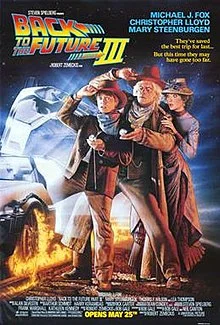
Back to the Future Part III (1990)

Mac Boyle August 20, 2019

Director: Robert Zemeckis

Cast: Michael J. Fox, Christopher Lloyd, Mary Steenburgen, Thomas F. Wilson

Have I Seen it Before: It is May, 1990. I am 5, going on 6. I don’t remember much about the world at that time, but I do remember having watched a VHS copy of Back to the Future Part II (1989) or about the 900th time, and being flooded with a cavalcade of TV spots for the forthcoming Part III. It was a wild time to be alive, having not seen all of the Back to the Future films. Today, I can’t quite wrap my head around it.

My dad comes home early from work. We pile into the car. I want to say I’m not aware of where we are going, but nearly 30 years since, my memory may not be ebbing, but it is smoothing out in the details. We go to the Annex 7.

We see Back to the Future Part III. 

I’ve thought about that particular screening at least once a month for the rest of my life. After the Annex 7 fell in favor of the Palace 12 (which in turn fell to the unrelenting force of indifference), I’ve wanted little more in life than to go back to the Annex 7 to watch anything. As it stands, I’ve got a real bad habit of leaving work early to go see movies, desperately trying to capture that feeling.

Flash forward a few months, and the film is released on video. It wasn’t quite priced to own yet, but rental places (they were kind of like Redboxes that you went inside; kids, ask your parents) would let you borrow it for a few days. To this day, one of the great creature comforts in life is some Chicken McNuggets and a viewing of this movie.

Set the time circuits ahead even a few more months. Now with a copy of Part III to call my very own—and perhaps single-handedly putting the brick and mortar movie rental business on the path to ruin—my aunt and uncle had come to visit. Looking at the small army of video tapes sitting on a shelf, they asked if they could borrow my copy of Part III, as they hadn’t seen it yet. The thought that I could share my excitement about movies with people was a revelation, and yet another high that I keep trying to chase as I type these words.

One final stop before we destroy this infernal contraption: Over a decade later, when I tried to made my first foray into forging a film of my own, I could think of no other piece of music to evoke the feeling of ending a long journey that you wouldn’t have given up for all the world. Thus, as we say goodbye to Really Good Man in The Adventures of Really Good Man (2002), the main theme of this film plays softly in the background.

There are few movies that are more central to my feelings about the movies than this particular film.

So, yes, to answer your question, I’ve seen Back to the Future Part III.

Did I Like It: In my review of Part II, I did indicate that as the years have gone by, my feelings about the sequels to Back to the Future (1985) have ebbed. The first film is about as perfect a story as exists in film, whereas the sequels are more consumed with self-consciously re-creating beats from the original film. Here that package is a little more satisfying, as it feels like the characters—mainly Marty (Fox)—attempt and are largely successful in breaking out of old patterns. The common complaint against Part II—that it isn’t a complete story—is quickly rectified here.

It’s also a brilliant way to make a western at a time in Hollywood when even Clint Eastwood (the biggest yellow-belly in the west) was not making cowboy pictures. Evoking the best of John Ford, the joy the filmmakers had in making something a little bit different pops out of every moment that takes place in the 19th century. Some might say that putting cowboys in the final installment of a teenage time travel comedy was a choice too far out of left field. I guarantee you, each and every person who says

And yet, I do have some qualms. The entire film is predicated on the established fact that Doc Brown (Lloyd) can’t repair the Time Machine in 1885 due to unsuitable replacement parts. What does Doc do the moment that Marty goes back to the future? Builds a Time Machine out of a train car. That doesn’t even begin to deal with why the Time Machine needed to be pushed up to 88 miles per hour, when it Part II it is clearly shown that while the flux capacitor activates at that speed, and yet can be overridden if enough electricity is sent through the Delorean’s mechanisms. I’ll admit that this may not be the most useful place for that discussion, and at least should have been a part of my review for Part II.

More likely, I’ve seen these films so many times that I’ve analyzed every moment of them beyond what one might consider rational.

And despite these logical inconsistencies, I love the film. Now, my prolonged answer to the question “had I ever seen it” might have something to do with that. And still, any time someone has an unkind word about the film, I get a brief flash of irrational irritation. Maybe I can’t be objective about it. Maybe I don’t want to be.
Tags back to the future part iii (1990), back to the future movies, time travel movies, robert zemeckis, michael j fox, christopher lloyd, mary steenburgen, thomas f wilson
Comment
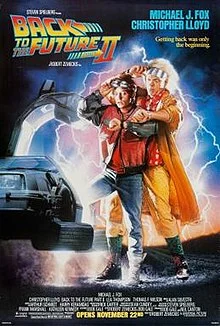
220px-Back_to_the_Future_Part_II.jpg

Back to the Future Part II (1989)

Mac Boyle August 20, 2019

Director: Robert Zemeckis

Cast: Michael J. Fox, Christopher Lloyd, Lea Thompson, Elizabeth Shue

Have I Seen it Before: It was probably on constant repeat in my house throughout the 90s. I would try to venture a guess as to how many times I’ve seen it, but I’d need a team of MIT mathematicians to crack the final number.

Did I Like It: That’s the real question, isn’t it?

Almost immediately upon release, the film was dismissed as somewhat incomplete. Even director Zemeckis eventually claimed that in the mad marathon to make this film and Back to the Future Part III (1990) in quick succession, Part II got the short shrift. 

After the final film in the series (hear me, Universal? Final.) was released, Part II got a slight re-evaluation, and was damned with a healthy dollop of faint praise. No longer an incomplete story, it was viewed as Act II of a larger story.

And that’s where we are now. I’ve been on the record in years past saying that the Back to the Future trilogy is the greatest six-hour movie that could theoretically exist. After repeat (and I do mean repeat watchings), I’ve changed my mind a little bit. While the original Back to the Future is one of the more tightly constructed stories ever committed to film, the fat on the sequels begin to show.

Whereas the first film is a masters class in set up and payoff, culminating in real change for the characters, the sequels are too often committed to the notion of repeating gags from the previous film, and having Marty (Fox) consistently run afoul of his own irrational hate for being called a chicken. 

Now, don’t get me wrong, those elements do work to some degree. The repeating elements—if viewed through any other prism than it reeks of studio notes to have the movies superficially resemble the original—could be looked at as a motif of the characters struggling to learn from their own past, and thus doomed to repeat it, regardless of their ability to travel amidst the fourth dimension. Someone could write a pretty in-depth analysis of this reading of the sequel from a Buddhist perspective, but please, don’t let it be me. And those motifs are only dropped when Marty—a character who diligently avoids anything resembling an arc throughout the whole trilogy—finally lets go of his ego.

It’s just not as tight as the first film, but then again few sequels are. But, to judge the series—and by extension, this film—against the other big trilogies (Star Wars, Indiana Jones, heck, even Star Trek’s II-IV), Part II delivers on the promise to be the darker entry. It becomes clear that any progress the characters made in the original film is tenuous, and could be torn asunder by their own complacency and a few well-timed bullets.

Also, there’s an entire plot wherein a hapless, mean-spirited oaf falls ass-backwards into becoming a casino and real estate tycoon (and by extension, one of the most powerful men in America), so you can’t get much darker than that.

But, I think the bigger test of the middle-entry of a trilogy is whether or not it is the breakneck adventure of the trilogy. The Empire Strikes Back (1980), Indiana Jones and the Temple of Doom (1984) and Star Trek III: The Search for Spock (1984) begin their stories and do not let up until the closing credits and the faint hope of a part three rings through our imaginations, all the while bringing their characters so close to the breaking point, that the catharsis of a conclusion is all that remains. On that front, Back to the Future Part II more than delivers. While one may want more of a complete story out of the proceedings, you can’t argue with the adventure of the pacing on this one.

Tags back to the future part ii (1989), back to the future movies, time travel movies, robert zemeckis, michael j fox, christopher lloyd, lea thompson, elizabeth shue
Comment

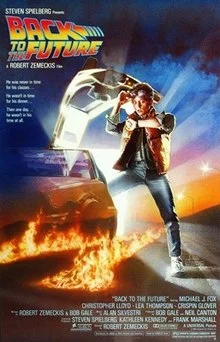
Back to the Future (1985)

Mac Boyle August 19, 2019

Director: Robert Zemeckis

Cast: Michael J. Fox, Christopher Lloyd, Lea Thompson, Crispin Glover

Have I Seen it Before: My parents like to tell a story about me—a little more than a week before my first birthday—enraptured by the movie as it played at the Admiral Twin Drive-in. That night I may have fallen asleep before the movie was over, but I assure you that I’ve more than made up for it since then.

Did I Like It: Can a movie live in your soul? Can a single film dictate a vast majority of one person’s aesthetic to the point where one becomes ever so slightly concerned that the only cogent thoughts he has ever had 

Can a film be perfect?

Yes, yes it can. The film doesn’t waste a single moment in its story-telling. Every moment builds on the developments that precede it. The time travel logic is unassailable, and that’s not something I can say for many time travel movies, including some of the sequels that follow this movie.

Look, if you came here looking for some kind of sober, level-headed admission of flaw in the film, then there’s the door.

But I could spend some time talking about some of the great parts of the film that don’t get enough credit. Lea Thompson might appear to be relegated to a basic ingénue role, but in reality she is the film’s secret weapon. I challenge you to name an actress who could on a dime turn from defeated, alcoholic housewife, to randy teenager, and still somehow stay maternal the whole time. You might come up with a Meryl Streep out there in the world who could make those changes with the same skill, but I guarantee there has never been and never will be a performer who could take all of those qualities, play a number of scenes where she unknowingly lusts after her son, and not make the film a pitch-black dark comedy in the process. Hell, she made large swaths of Howard the Duck (1986) watchable. That she is not one of the most heralded screen presences of all time is beyond me. Maybe she had enough sense to not want that kind of scrutiny. Maybe Lea Thompson is just too good for the movies.

But even all that seems superfluous when we’re talking about a prime candidate for my personal canon of greatest films of all time. If you haven’t seen it, I don’t understand what you have been doing with your time. If you have seen it and aren’t as enamored of it as the preceding words would insist, I don’t know what to do with you. You should go rewatch it and do it correctly this time. If you are as in love with this movie as I am, you should still rewatch it. There are few things in life which are more enjoyable.

Tags back to the future (1985), time travel movies, back to the future movies, robert zemeckis, michael j fox, christopher lloyd, lea thompson, crispin glover
Comment

Powered by Squarespace

Party Now, Apocalypse Later Industries

Where creativity went when it said it was going out for cigarettes.

Where creativity went when it said it was going out for cigarettes.