Party Now, Apocalypse Later Industries

Where creativity went when it said it was going out for cigarettes.
  • Home
  • BOOKS
    • THE ONCE AND FUTURE ORSON WELLES
    • IF ANY OF THESE STORIES GOES OVER 1000 WORDS...
    • ORSON WELLES OF MARS
    • THE DEVIL LIVES IN BEVERLY HILLS
    • A LOSS FOR NORMALCY
    • RIGHT - A NOVEL OF POLITICS
  • PODCASTS
    • Beyond the Cabin in the Woods
    • THE HOLODECK IS BROKEN
    • THE FOURTH WALL
    • As The Myth Turns
    • FRIENDIBALS! - TWO FRIENDS TALKING ABOUT HANNIBAL LECTER
    • DISORGANIZED! A Criminal Minds Podcast
  • MOVIE REVIEWS
  • BLOGS AND MORE
    • Bloggy B Bloggington III, DDS
    • THE HOLODECK IS BROKEN BLOG
    • REALLY GOOD MAN!
  • Home
    • THE ONCE AND FUTURE ORSON WELLES
    • IF ANY OF THESE STORIES GOES OVER 1000 WORDS...
    • ORSON WELLES OF MARS
    • THE DEVIL LIVES IN BEVERLY HILLS
    • A LOSS FOR NORMALCY
    • RIGHT - A NOVEL OF POLITICS
    • Beyond the Cabin in the Woods
    • THE HOLODECK IS BROKEN
    • THE FOURTH WALL
    • As The Myth Turns
    • FRIENDIBALS! - TWO FRIENDS TALKING ABOUT HANNIBAL LECTER
    • DISORGANIZED! A Criminal Minds Podcast
  • MOVIE REVIEWS
    • Bloggy B Bloggington III, DDS
    • THE HOLODECK IS BROKEN BLOG
    • REALLY GOOD MAN!

A Blog About Watching Movies (AKA a Blog in Search of a Better Title)

IMG_4267.JPG

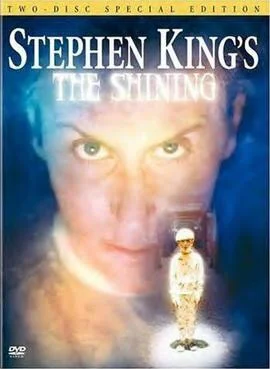
The Shining (1997)

Mac Boyle August 26, 2018

Director: Mick Garris

Cast: Rebecca De Mornay, Steven Weber, Melvin Van Peebles, Courtland Mead, some truly awful mid-90s CGI.

Have I Seen It Before: The mere notion of watching it up until my deep-dive into Shining-ology this week seemed ridiculous. And yet, here I am.

People often complain when a filmed adaptation is released, if the subsequent work doesn’t strictly adhere to the source material. Those who adore Stephen King’s original novel The Shining decry Stanley Kubrick’s 1980 film of the same name. King himself is among the most prominent of this ilk. I tend to disagree with them, both in general and specifically in this case. There’s something interesting about a true adaptation, that a transcription just can’t quite accomplish. See Watchmen (2009) for a pretty perfect example of this phenomenon.

But, King was unhappy with the Kubrick film and he thought he could do better. So he tried. He managed to retrieve the rights to his own novel from Kubrick (for a price that various sources indicate was 2 million dollars, and an agreement that King cool it with his criticism of the original film), wrote a 4 1/2 hour teleplay, and had the company film the thing in Stanley Hotel, the same inn that had inspired him to

It’s a TV miniseries from the 90s. Thus, it has what you would think for production values (to say nothing of the special effects), and the acting to back it up. One particularly egregious example is a series of helicopter tracking shots following the Torrance’s to the Overlook. Kubrick already mastered such a shot with the opening of his movie. Inviting the comparison by trying to work in the same milieu isn’t doing your movie any favors. It is not of quality anywhere near the Kubrick original, even if it is occasionally slavish to the novel.

But that shouldn’t surprise you. What might surprise you is the points where King actually diverts from his novel. An extended epilogue is attached, showing Dick Hallorann (Melvin Van Peebles) very much a part of the surviving Torrance’s lives. Young Danny (Courtland Mead) is graduating from High School, and as it turns out, he looks exactly like his vision from many years ago of his imaginary friend, Tony (Wil Horneff). Yikes.

Elsewhere, the smoky wreck of the Overlook is being rebuilt. Dun dun dun. Sorry, Mr. King. Your old friend Kubrick had the Overlook still standing at the end of his version of your story. It may work better, but the complaint of a poor adaptation rings false with this decision. You desperately want Jack Torrance (Steven Weber) to be something of a sympathetic figure, but negating his sacrifice by rebuilding the hotel is a little like those helicopter shots of the VW Bug: It’s been done before.

Tags the shining, Steven Weber, 1990s, Rebecca De Mornay, 1997, Courtland Mead, Mick Garris, Melvin Van Peebles
Comment
220px-The_Shining_(1980).png

The Shining (1980)

Mac Boyle August 19, 2018

Director: Stanley Kubrick

Cast: Jack Nicholson, Shelley Duvall, Danny Lloyd, Scatman Crothers

Have I Seen it Before: I’ve always been the watcher of this movie…

Did I Like It: What’s not to like? Yes, Mr. King, we’ve already heard from you.

Before making films, Stanley Kubrick was one of the premiere still photographers in the world. As a filmmaker, he never seemed particularly interested in being a dramatist, and stayed firmly entrenched in his roots. Thus, as a director he ends up being more of an impressionist, if one can be such and still make studio pictures. Thus, the film is a Rorschach test, providing any watcher with exactly what they want to see (see Room 237 (2012)). And thus, it’s only partially an adaptation of the original King novel.

Kubrick, though fills his movie with general dread for as long as he can, and then erupts the film King throughout his work has been very interested in mythology, perhaps at the expense of actual horror. Kubrick just wants us to feel the horror, and for my money, he mostly succeeds, while at the same time giving us far more (although perhaps not as much as some others would have us believe) to chew on.

Much has been made of King’s displeasure with the book, and beyond the reality that Kubrick’s movie is not a faithful adaptation, I just don’t see it. He has—at times—complained about how he believed Jack Torrance as played by Jack Nicholson appears to be a madman from the first frame, making his transformation to axe-wielding maniac more of a tragedy. Aside from a simmering hostility that Nicholson seems to have as part and parcel of his film persona, I just don’t quite see it. 

King’s book is a fine book, but not his best. Whereas with the film—with the sheer depth of analysis that can be made about the movie is staggering—is a far more memorable experience.

Tags the shining, stanley kubrick, jack nicholson, shelley duvall, scatman crothers, 1980, 1980s
Comment
220px-Room_237_(2012_film).jpg

Room 237 (2012)

Mac Boyle August 19, 2018

Director: Rodney Ascher

Cast: Bill Blakemore, Geoffrey Cocks, Juli Kearns, John Fell Ryan

Have I Seen it Before: Yes. I’m curious to see if I have the same reaction to it on the second go around.

Did I Like It: To ask that question, you almost have to reckon with whether or not you believe anything in the movie. I land somewhere in the middle of this question (which I’ll get to in a minute), but thus I land somewhere in the middle of the question of whether or not I like it.


“Now, if you’ll allow me to make a little bit of a link here…”

And with that quote, we’re off to the races.

Okay. So. Room 237. A lot of ideas in the film. In some case, I may be using the term “ideas” loosely in some cases. 

Visually, I think the film is by and large lackluster. Aside from some rather standard b-roll, and a few bordering-on-clever weaves into other works of the Kubrick oeuvre, the film plays out largely like a podcast (which seems like a strange criticism coming from me, but I’m not putting my stuff out on Blu Ray). It floats along on its ideas, and the ideas only occasionally enthrall, and even more rarely fully persuade.

The theories about Stanley Kubrick’s The Shining (1980) put forward include: 

  • That the film is Kubrick’s attempt to deal with mythological idea, specifically that of the Minotaur (I think)

  • That the film is a dissertation on the Holocaust.

  • That the film is a dissertation on the genocide of Native Americans.

  • That the film is Kubrick’s confession (for lack of a better term) for having participated in some level of fakery surrounding the Apollo 11 moon landing in 1969.

Naturally, that last claim is the hardest one to swallow, but each seems to be grasping at straws. 

And yet…

The fundamental knowledge of Stanley Kubrick as such a particular, exacting filmmaker, forever possessing the still photographer’s eye for every detail in the frame, some of the things these various interviewees bring up are thought provoking. To illustrate the general arc of my thinking on some of these questions, I present the rhetorical process I went through on the question of lunar fakery:

  1. Do I think that the moon landing was faked? Of course not.

  2. Do I think that it’s possible that some of the footage (especially the near-live footage of Armstrong) might have been goosed or sweetened with the assistance of Hollywood magic? Possibly.

  3. Do I think that Stanley Kubrick would have had the skills to get such a job done? Sure.

  4. Do I wonder why Danny (Danny Lloyd) is wearing that Apollo 11 sweater? Hey, yeah. That is weird. Why would Kubrick put such a specific thing in the movie?

  5. Is it possible that Stanley Kubrick was just fucking with us? …Yeah. That seems like the Occam’s Razor explanation.

Tags Room 237, Documentary, 2012, 2010s, the shining
Comment

Powered by Squarespace

Party Now, Apocalypse Later Industries

Where creativity went when it said it was going out for cigarettes.

Where creativity went when it said it was going out for cigarettes.