
Party Now, Apocalypse Later Industries

Where creativity went when it said it was going out for cigarettes.
  • Home
  • BOOKS
    • THE ONCE AND FUTURE ORSON WELLES
    • IF ANY OF THESE STORIES GOES OVER 1000 WORDS...
    • ORSON WELLES OF MARS
    • THE DEVIL LIVES IN BEVERLY HILLS
    • A LOSS FOR NORMALCY
    • RIGHT - A NOVEL OF POLITICS
  • PODCASTS
    • Beyond the Cabin in the Woods
    • THE HOLODECK IS BROKEN
    • THE FOURTH WALL
    • As The Myth Turns
    • FRIENDIBALS! - TWO FRIENDS TALKING ABOUT HANNIBAL LECTER
    • DISORGANIZED! A Criminal Minds Podcast
  • MOVIE REVIEWS
  • BLOGS AND MORE
    • Bloggy B Bloggington III, DDS
    • THE HOLODECK IS BROKEN BLOG
    • REALLY GOOD MAN!
  • Home
    • THE ONCE AND FUTURE ORSON WELLES
    • IF ANY OF THESE STORIES GOES OVER 1000 WORDS...
    • ORSON WELLES OF MARS
    • THE DEVIL LIVES IN BEVERLY HILLS
    • A LOSS FOR NORMALCY
    • RIGHT - A NOVEL OF POLITICS
    • Beyond the Cabin in the Woods
    • THE HOLODECK IS BROKEN
    • THE FOURTH WALL
    • As The Myth Turns
    • FRIENDIBALS! - TWO FRIENDS TALKING ABOUT HANNIBAL LECTER
    • DISORGANIZED! A Criminal Minds Podcast
  • MOVIE REVIEWS
    • Bloggy B Bloggington III, DDS
    • THE HOLODECK IS BROKEN BLOG
    • REALLY GOOD MAN!

A Blog About Watching Movies (AKA a Blog in Search of a Better Title)

220px-Star_Trek_II_The_Wrath_of_Khan.png

Star Trek II: The Wrath of Khan (1982)

Mac Boyle February 17, 2020

Director: Nicholas Meyer


Cast: William Shatner, Leonard Nimoy, DeForest Kelley, Ricardo Montalbán


Have I Seen it Before: Hoo, boy. Long established in my family lore is the screening my mother went to at a second-run theater in the summer of 1984. As the USS Reliant exploded in a wave of the Genesis Effect, I—a learned elder, as far as fetuses were concerned—decided to give my ma a bit of a break and cut it out with the kicking and whatnot. It’s entirely possible that while some babies were exposed to classical music or the neurosis and bitterness of their parents in utero, I absorbed the bombastic score of James Horner and the sneering villainy of Khan Noonien Singh (Montalbán) as the foundation of my very being.


The first time I remember watching the movie while sentient was on a feeble VHS copy. I couldn’t have been more than ten years old and spent the rest of the day giddily recounting the plot to anyone who would listen. This time, my poor suffering mother got the raw end of the deal and had to hear a ten-year-old’s impression of a Ceti eel.


During this particular screening, I was able to lip sync every line of dialogue. I even felt the need to argue with several of the trivia questions before the feature presentation. Because they were wrong.


Yes. I’ve seen it a couple of times.


Did I Like It: At one point after the nadir of Star Trek: Nemesis (2002) and the particularly wheel-spinning seasons of Star Trek: Enterprise, I wondered quietly whether I actually didn’t care much for Star Trek at all, but was so in love with this film that I was willing to give every other entry in the series a pass because it shared some basic elements with this film.


It is a thrilling story, told at a breakneck pace that still manages to let smaller character moments have their due time. It is about friendship, and aging, and revenge, and sacrifice, and living the first, best destiny you know in your bones. It is told with a startling simplicity that allows fully-steeped fans and newcomers alike to delight in the proceedings. Any time I am trying to create a story on my own, I’m reaching for an experience somewhere in the vicinity of this film.


It is not only my favorite Star Trek film, it is certainly one of my favorite movies of all time. It may be my favorite film of all time, although I tend to blanche at ranking these things so precisely.


Every time I see the film, I notice something new. During this particular screening I noticed that Chekov (Walter Koenig) is not seen on screen after purging himself of the Ceti eel without cotton in his bloodied ear. Also, somehow I had never put together that the Genesis Effect billowing out of the Reliant also caused the Mutara Nebula to collapse in on itself, harnessing the material of the nebula to create the Genesis Planet that would be the setting of most of the action of Star Trek III: The Search For Spock (1984). I honestly don’t know how it has taken longer than my actual lifespan to put that one together. It is a film that keeps on giving.


And yet, it is not a perfect film. The subplot with Midshipman Preston (Ike Eisenmann) doesn’t resonate, and it is only in the director’s cut (first released in 2002) that things are slightly illuminated, although I still don’t understand why Scotty (James Doohan) brought the poor suffering crewman to the bridge first, and not directly to sickbay. Additionally, the effects of the Genesis Cave on the Regula planetoid are alternately a triumph of matte work (back when such a thing was still done) and a completely befuddling choice in animated optical processing. But the flaws give me comfort. Even if I am flawed in my own work, I can still reach for the ideal. 


As with most films, watching it at home on a television is only imitating the experience in many ways. I had the delight to see it a few years ago during a Fathom Event screening. Seeing it projected on the big screen was a blissfully different experience. However, that screening was sparsely populated. This time, I saw it in conjunction with a live event hosted by none other than William Shatner. While the Captain Kirk emeritus was understandably more interested in talking about Star Trek V: The Final Frontier (1989), seeing the film with a packed and enthusiastic crowd was sublime. The cheering for cast members during the opening credits, the polite applause for GOAT writer-director Nicholas Meyer (which I believe he would have found staggeringly appropriate), the laughing at jokes I had long since internalized, and the genuine feeling that accompanied the climax gave every inch of the film a new life, as if it had been goosed by the Genesis Wave itself. I couldn’t help but feel like Kirk at the end. A movie that was old news at my birth was all new again.


I couldn’t help but feel young.
Tags star trek ii: the wrath of khan (1982), star trek movies, nicholas meyer, william shatner, leonard nimoy, deforest kelley, ricardo montalbán
Comment
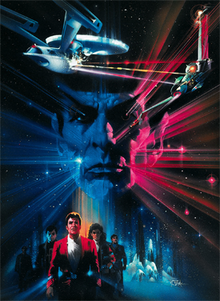
Star_Trek_III_The_Search_for_Spock.png

Star Trek III: The Search for Spock (1984)

Mac Boyle September 8, 2019

Director: Leonard Nimoy

Cast: William Shatner, DeForest Kelley, James Doohan, Christopher Lloyd

Have I Seen it Before: What, are you trying to tell me Spock is alive again? 

Yes, of course I’ve seen it.

Did I Like It: Let’s really drill down on something that has been long accepted as cardinal truth of this series.

Even-numbered films are great. Odd-numbered movies are the pits.

And yet, Star Trek Nemesis (2002) is the tenth film in the series and Star Trek Into Darkness (2013) is the twelfth, and they both are the cinematic equivalent of drinking chancey milk that is well-past its due date.

So, too is it with this film. It largely works, and is early enough in the franchise’s motion picture history to conclusively put the even/odd framework about these films in serious doubts.

It’s hard to doubt that it suffers ever so slightly by having to follow the series apex, Star Trek II: The Wrath of Khan (1982), but that does feel like an unfair judgment. Nemesis and Into Darkness tried to steal various aspects of plot and pacing from that far-better film, and never quite rise to the level of competent mimicry. 

Here, Nimoy appears to be aware of his potential shortcomings as a first-time director (a self-awareness that William Shatner never quite mastered five years later in Star Trek V: The Final Frontier [1989]) and tries to learn his craft before attempting to master it. Therefore, the film echoes more of a feeling or motif from the previous film. This may be in no small part due to James Horner returning to produce the score, but every frame of the film feels as if it is a companion piece to Khan, not a blind attempt to replicate it.

It helps that this film has its own story to tell. Part mystic resurrection tale, part classic duke-it-out-with-the-Klingons episode from the original series, and just enough of a heist story to keep things interesting.

Another element of note is to remember that—along with this film’s follow-up, Star Trek IV: The Voyage Home (1986)—introduce so many elements to Trek that will be load bearing for many years to come. The Excelsior and the Klingon Bird-of-Prey are first glimpsed here. The models of both ships are reused by Trek shows well into the twenty-first century, and much of the footage of the new enemy ship is reused for nearly the same length of time.

Also, one can’t help but dwell on the casting for the supporting roles. The studio balked at the idea of Christopher Lloyd playing Commander Kruge, the heavy. They could not move past the image of the actor as Reverend Jim on Taxi. Knowing a thing or two about being type-cast from appearances on a TV show, Nimoy insisted. One wonders if he would have ever been on the radar of Robert Zemeckis when Back to the Future (1985) began filming around the time fo the film’s release. I don’t want to live in that world. In fact, I want to live in a world with the most possible performances by Christopher Lloyd as possible, so I’ll be damned if I view this as one of the typical odd-numbered Trek films.

Tags star trek iii: the search for spock (1984), star trek movies, leonard nimoy, william shatner, deforest kelley, james doohan, christopher lloyd
Comment
220px-Star_Trek_V_The_Final_Frontier.png

Star Trek V - The Final Frontier (1989)

Mac Boyle August 16, 2019

Director: William Shatner

Cast: William Shatner, Leonard Nimoy, DeForrest Kelley, Laurence Luckinbill

Have I Seen it Before: Sybok, please…

Did I Like It: This is the deep dark question that ever Star Trek fan must reckon with. Many don’t reckon with it at all and are content to write it off as forever the worst film in the entire series. These people clearly have never seen Star Trek Nemesis (2002). Clearly.

That being said, one cannot deny that the film is riddled with problems. Do they stem from a studio unwilling to let the vision for the film come to life or other production limitations that no filmmaker could have overcome? Or is the film weighed down by a director who just didn’t understand the material (despite being an integral part of that material for over twenty years)?

As with so many things, there appears to be an either/or choice in this case. Shatner, in his first and only attempt to direct a major motion picture, had lofty ideas that Paramount grew increasingly disinterested in as production marched along. A Writer’s Guild strike in 1988 didn’t help matters, either. And yet, I always got the impression that Shatner was never terribly interested in making a Star Trek film, but aptly understood that after Nimoy parlayed work on Star Trek III: The Search for Spock (1984) and Star Trek IV: The Voyage Home (1986) into a solid directing career, this was his chance to branch out.

The film suffers from all of these problems, and there are elements that never quite gel.

It’s starts with… an obliterated desert pockmarked with steaming holes? And that’s supposed to be the extended Lawrence of Arabia (1962). That Shatner wanted to make the Lawrence of Star Trek films that deep-dives into the big questions of the universe is admirable, but it’s hard to blame Paramount for wanting another Voyage Home or Star Trek II: The Wrath of Khan (1982), and trying to gently redirect things. It’s also worth noting that the search for God was the basic framework for an early version of what became Star Trek: The Motion Picture (1979), and everyone involved blanched at the notion then, but cooler heads did not prevail here.

The power Sybok holds over his people and eventually the Enterprise crew is amorphous and ill-defined, not unlike the Temporal Nexus in Star Trek Generations (1994). It’s a common trait of the least engaging films in the series that the fundamental problem is that the plot just doesn’t work.

There are things that irritate the deep-canon Star Trek fan, but others might not notice. Quadrants are huge. It takes decades to traverse them, but this crew makes it to the center of the galaxy in (suddenly, inexplicably) in less than reel of film. Large swaths of the crew turn on Captian Kirk on a dime. Also, not for nothing, everything about that scene in the turbolift shaft doesn’t make sense. There’s no way the USS Enterprise, NCC-1701-A has that many decks, and they increase in number as you go down, not up.

Sigh.

Now that I’ve beaten up on the film in most of the familiar ways, and a few I hope aren’t as obvious, let’s go way off the path of accepted Trek dogma (and become the laughing Vulcan inside each of us?) and praise the movie for what it gets right.

If—at it’s core—the original series is truly about the friendship between Kirk, Spock, and McCoy, then this film does a profound job of having those three characters live within that friendship. 

The score is fantastic. Jerry Goldsmith returns to the series for the first time since The Motion Picture. His rousing score is often the best part of any of the films/shows he’s associated with, and the fact that Paramount spared no expense here definitely elevates the more groan-worthy moments. One wonders if the film works even less without the music, and the studio relented to the idea of a more majestic score to try to rescue things.

That’s… it on the good stuff, as it turns out. So, the film doesn’t really work, as it turns out. But it is two hours with some version of the original Star Trek cast. We don’t get those every couple of years, so let’s ease up on the movie, shall we? Again, I guarantee it’s better than Nemesis.

Tags star trek v: the final frontier (1989), star trek movies, william shatner, leonard nimoy, deforrest kelley, laurence luckinbill
Comment

Powered by Squarespace

Party Now, Apocalypse Later Industries

Where creativity went when it said it was going out for cigarettes.

Where creativity went when it said it was going out for cigarettes.