Party Now, Apocalypse Later Industries

Where creativity went when it said it was going out for cigarettes.
  • Home
  • BOOKS
    • THE ONCE AND FUTURE ORSON WELLES
    • IF ANY OF THESE STORIES GOES OVER 1000 WORDS...
    • ORSON WELLES OF MARS
    • THE DEVIL LIVES IN BEVERLY HILLS
    • A LOSS FOR NORMALCY
    • RIGHT - A NOVEL OF POLITICS
  • PODCASTS
    • Beyond the Cabin in the Woods
    • THE HOLODECK IS BROKEN
    • THE FOURTH WALL
    • As The Myth Turns
    • FRIENDIBALS! - TWO FRIENDS TALKING ABOUT HANNIBAL LECTER
    • DISORGANIZED! A Criminal Minds Podcast
  • MOVIE REVIEWS
  • BLOGS AND MORE
    • Bloggy B Bloggington III, DDS
    • THE HOLODECK IS BROKEN BLOG
    • REALLY GOOD MAN!
  • Home
    • THE ONCE AND FUTURE ORSON WELLES
    • IF ANY OF THESE STORIES GOES OVER 1000 WORDS...
    • ORSON WELLES OF MARS
    • THE DEVIL LIVES IN BEVERLY HILLS
    • A LOSS FOR NORMALCY
    • RIGHT - A NOVEL OF POLITICS
    • Beyond the Cabin in the Woods
    • THE HOLODECK IS BROKEN
    • THE FOURTH WALL
    • As The Myth Turns
    • FRIENDIBALS! - TWO FRIENDS TALKING ABOUT HANNIBAL LECTER
    • DISORGANIZED! A Criminal Minds Podcast
  • MOVIE REVIEWS
    • Bloggy B Bloggington III, DDS
    • THE HOLODECK IS BROKEN BLOG
    • REALLY GOOD MAN!

A Blog About Watching Movies (AKA a Blog in Search of a Better Title)

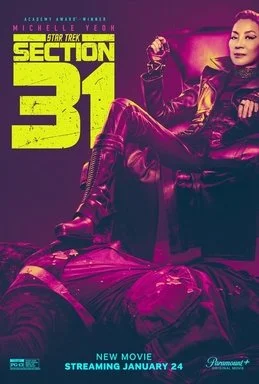
Star Trek: Section 31 (2025)

Mac Boyle January 26, 2025

Director: Olatunde Osunsanmi

Cast: Michelle Yeoh, Omari Hardwick, Sam Richardson, Kacey Rohl

Have I Seen it Before: Never. Brand new. Weird moment when for a day or so—although it happens more and more frequently these last few years—when somebody could ask me “Have you seen all of Star Trek” and I have to answer “not yet.” Even weirder still is the brief moment  when someone can ask me, “Have you seen all of the Star Trek movies?” and I have to say I’m working on it.

Did I Like It: Assessing any Star Trek movie begs more than a few questions, although as I continue to write this review I find those questions to be more than a little bit inter-related. First—and this question really ought to be used to judge any film—does it succeed on its own terms? On this front, yes, I think it does. It wants to be a fun, light adventure a la Guardians of the Galaxy (2014), and while one might be able to quibble with just how naturally a bunch of goofballs on a heist format onto Roddenberry’s utopia, it’s clear that the movie has decided what it wants to be and follows through on that.

Second question: Does the movie work for someone who isn’t already steeped in the lore of Trek? Frankly, all of the great Trek films straddle the line, bringing in elements of what came before but making it accessible to a wider audience. Here, Section 31 works pretty well. Explaining just who Georgiou (Yeoh) is and her previous activities is dispensed with as quickly as possible without just directing viewers to the first three seasons of Star Trek: Discovery. But other than that, these are new characters who we are just getting to know. A fan like myself will see Rachel Garrett (Rohl) and know fate will take her in the future*, but Joe Everybody off the street will just be able to see her as the archetypical Starfleet officer, futilely trying to bring order to the chaos on display. This might be something I would recommend to someone just coming in to the franchise.

Finally, and this question can plague many of the other Trek films: Is it worthy of being a feature-length story, or is it really an extended episode? Star Trek Insurrection (1998) is often maligned for being an extended episode and Star Trek: The Motion Picture (1979) started life as a pilot to an eventually abandoned second series with the original crew, and never quite outruns the gravity of those constrictions. This, too, was originally to be the first episode of a spinoff starring Yeoh, but after she won the Oscar, cooler head prevailed, and we are left only with this “event movie.” There’s room to check in with this rag-tag team in the future if this film works, but it definitely feels like a pilot for things that will never come. I was prepared to answer this question and only view Section 31 as something of a mixed bag, but then I remembered what this really means for the future of Trek. After a whirlwind few years where we were treated to a number of series, the streaming wars appear to have ended with no real winners. By committing not to multi-year series with inevitably diminishing numbers of viewers, changing the way Star Trek comes to us may yet widen the lens. We could see more 24th Century stories a la the hinted Picard sequel, Legacy. Indeed, the limits of what could be done may no longer exist. If that ends up being the case, Section 31 may end up being a noble experiment, indeed.

*In addition to being the only real clue that this story takes place roughly forty years after Star Trek VI: The Undiscovered Country (1991) and about forty years before the beginning of Star Trek: The Next Generation.

Tags star trek: section 31 (2025), star trek film series, olatunde osunsanmi, michelle yeoh, omari hardwick, sam richardson, kacey rohl
Comment
220px-Star_Trek_The_Motion_Picture_poster.png

Star Trek: The Motion Picture (1979)

Mac Boyle September 16, 2019

Director: Robert Wise

Cast: William Shatner, Leonard Nimoy, DeForest Kelley, James Doohan

Have I Seen it Before: There’s something about this movie that makes it feel like I’ve never quite seen it all the way through. Like they are still making the movie as I’m watching it.

Did I Like it: Now, that above thought could be taken as a dig about its interminable runtime. It’s only just over two hours, but it feels like 40 years passes from the prelude to the final warp effect.

But it’s worse than that. The film’s plodding pace is a matter of accepted film and Trek canon. Given the rampant, directionless egos (mostly in the form of Gene Roddenberry) that tried to come together to make the film, it’s a minor miracle that any moment in the film works, even if the whole isn’t quite the sum of its parts. The movie spends a befuddling amount of time featuring characters looking out windows or at viewscreens, but the expression on the face of Kirk (Shatner) as he sees the newly re-fit Enterprise for the first time is one of the best performances the actor has ever given.

Other movies—and even movies in the science fiction genre—have a similarly deliberate pace. Blade Runner (1982). 2001: A Space Odyssey (1968). When I finally got a chance to see 2001 on the largest screen possible, the film transformed before my eyes. While most of Star Trek was meant for the smaller screen, maybe when I finally saw this first film in the way it was meant to be seen, it would improve.

Sadly, it does not. I’m struck by and expanding realization that Kubrick truly knew what he was doing, as even on the big screen, this film can't embrace the majesty of its more traditional special effects, or the weirdness of its more oblique imagery. The star gate via the monolith is a panic inducing experience, whereas the V’Ger is cheap and predictable. The Discovery seems like a real spaceship, whereas there are shots (and there are many, loving shots) of the Enterprise where the distant edges of the ship blink in and out existence.

How a film could be edited this poorly under the auspices of Wise, one of the greatest editors in the history of the moving picture is beyond me.

Maybe the voyages of the various crews of the Enterprise are better left to the small screen.

Maybe the odd-numbered films aren’t very good.

Tags star trek the motion picture (1979), robert wise, star trek film series, william shatner, leonard nimoy, deforest kelley, james doohan
Comment

Star Trek IV: The Voyage Home (1986)

Mac Boyle August 21, 2019

Director: Leonard Nimoy

Cast: William Shatner, Leonard Nimoy, DeForrest Kelley, Catherine Hicks

Have I Seen it Before: Honestly? I really think this was the first piece of Star Trek I ever watched. For any number of years, my only copy of the film was on VHS recorded off the broadcast of the film on March 28th, 1993. I know this because the movie was interrupted every few minutes with an add for the 65th Academy Awards the next night. Not the best way to watch a movie repeatedly, but there it is.

Did I Like It: It’s an even numbered movie, right? It’s written—at least partially—by Nicholas Meyer, right?

As I mentioned before, this was—to my memory—the first piece of Star Trek I had ever taken in. As anyone who knows me can attest, that moment proved seminal to me, and as such it can’t be denied that The Voyage Home is perhaps the perfect gateway piece of Star Trek ever constructed. The Wrath of Khan (1982) may be the superior film, and some of the J.J. Abrams movies may possess a more self-assured modern blockbuster feel, but this is the one that is a straight ahead crowd-pleasing comedy.

And every inch of the film is devoted to that effect. Large portions of the screenplay were cannibalized from material that didn’t make it into Meyer’s fish-out-of-water Time After Time (1979). The score—by Leonard Rosenman—is a jaunty skip through San Francisco of the 1980s. It’s exactly the right score for this kind of movie, and I say this while maintaining that Rosenman’s score for Robocop 2 (1990) is perhaps the most incorrect score ever attached to a particular movie. Even the ingenue role played by Catherine Hicks was originally written for Eddie Murphy, although one imagines there was a fair amount of re-writing to make the transfer the roles between the two performers.

It’s also a comedy that likely wouldn’t work under any other circumstances. Nimoy and the writers had an intimate understanding of—if not Trek lore—the beating heart of what made Trek continue to work. The jokes spring out of the chemistry between the characters, and I challenge anyone to find another comedy film wherein the characters have twenty years of interplay to inform their reactions. I’ll wait here in the park for your answer. See? That hypothetical film just doesn’t exist.

Tags star trek iv the voyage home (1986), star trek film series, time travel movies, leonard nimoy, william shatner, deforrest kelley, catherine hicks
Comment
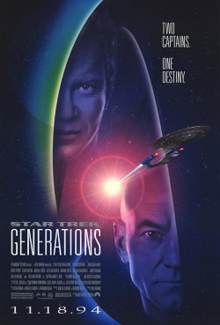
S07-Star_Trek_Generations-poster_art.png

Star Trek: Generations (1994)

Mac Boyle July 9, 2019

Director: David Carson

Cast: Patrick Stewart, Brent Spiner, William Shatner, Whoopi Goldberg

Have I Seen it Before: I saw it before I ever saw it. More on that in a minute.

Did I Like It: It’s exactly what we the fans probably wanted from a first Next Generation film, but it may be that we don’t really know what we want, as the film ultimately winds up a disappointment.

I feel this film far more than I think about it, and I think that’s the fundamental truth about it. 

It is the summer of 1994. Star Trek: The Next Generation has just gone off the air with an epic, perfectly-formed final episode that doesn’t really serve as a finale. All of the characters—in true TV fashion—haven’t changed. The TV audience—including 9-year-old me—are fine with that. We know that while this is the end of the weekly adventures of the crew of the USS Enterprise NCC-1701-D, and we wouldn’t have to wait long to see them again.

And so we come into the first Next Generation film with a list of things that the show had never quite addressed. Could the saucer section of the Enterprise act as an escape pod for the rest of the ship and—if need be—land safely on a planet? Who were the people that served aboard the presumably Excelsior-class Enterprise-B? What could possibly bring down the Enterprise-D? What happened to James T. Kirk (Shatner) after Star Trek VI: The Undiscovered Country (1991)? Was he still alive in the 24th century, the time of Picard (Stewart) and company*?

This film lives in a unique space in my brain. At a Star Trek Convention that summer, I managed to get a hold of the screenplay for the film for twenty dollars. It was such a wild boon, knowing what was going to happen in a movie months before its release. I was transfixed, and have been perhaps compulsively interested in screenwriting ever since**. I was struck by the interplay between Captain Kirk and Picard, two men who could understand something about each other that almost no one else could. I took the destruction of the Enterprise-D as a hit to the gut. That ship was the safest of safe places for seven years, and in this watching I was struck by the despair of the kids being evacuated during the destruction scene (even though that evacuation doesn’t really make any sense) still manages to hit me.

And with all of this fundamentally interesting stuff, the film just doesn’t work.

The time travel is all over the place, even more starkly noticeable as the film comes sandwiched between two of the better time travel stories the franchise has ever done, the aforementioned final episode “All Good Things…” and the next Next Generation film, Star Trek: First Contact (1996). 

The inclusion of not the whole original crew in the first reel, but instead just Scotty (James Doohan) and Chekov (Walter Koenig) feels off. The parts were clearly written for Bones and Spock, but instead the 90’s version of a control-F was done by way of a re-write. Why was Chekov so interested in taking over the medical care of the Lakul survivors? Why was he recruiting nurses out of the reporters? It boggles the mind why this scene didn’t get another pass, or there wasn’t a more concerted effort to make Nimoy, Kelley and the rest of the remaining crew more happy with the prospect of one last hurrah.

I can’t hate the film, but it is absolutely impossible to get over it’s more glaring flaws. Which, for an even-numbered film in the era when the even/odd dichotomy of Star Trek films still mattered, that’s not so bad.

Really? Had they not already made the episode in their third season, a re-worked version of “Yesterday’s Enterprise” might have been the perfect framework for a Kirk meets Picard story.

And it would have allowed the entire original crew to actually have things to do in the film, enough so that the actors might have been inspired to show up.


*Indeed, entire sections of the Star Trek: The Next Generation Technical Manual by Rick Sternbach and Michael Okuda and the first edition of the Star Trek Encyclopedia by Michael and Denise Okuda are devoted to some of these questions, to the point where I think those authors could have made a level-headed pitch at a story-by credit on this film. How do I know all of this? It was a weird childhood and there may have been some—properly researched, mind you—fan fiction written there in the 90s. Lay of me.

**It should bear mentioning that I also got a glimpse of the screenplay for Star Trek Nemesis (2002) months before that film was released via a leak on the internet and was filled with a melancholy that could only be countered by the hope that the film would improve in the directing or the editing. It wasn’t. It was somehow worse than the flimsy script. So, point for Generations on being an entertaining read, if an uneven final product.

Tags star trek generations (1994), david carson, patrick stewart, william shatner, brent spiner, whoopi goldberg, star trek film series
Comment
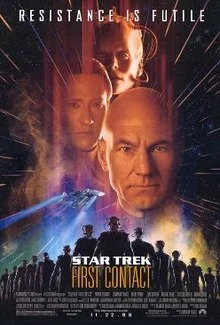
220px-Star_trek_first_contact_poster.jpg

Star Trek: First Contact (1996)

Mac Boyle July 4, 2019

Director: Jonathan Frakes

Cast*: Patrick Stewart, Brent Spiner, James Cromwell**, Alfre Woodard

Have I Seen it Before: Oh, yes… I have the most vivd memory of coming out of the theater in November 1996 getting picked up by my parents. When they asked me how it was, I said, “The greatest two hours*** of my life.” They said, “You’re young yet.” Nearly twenty-five years later, I’m still not entirely sure what they were talking about.

Did I Like It: See the above comment.

At their core, the four films based on The Next Generation are a mixed bag. The producers behind the various television series of the era maybe never quite got out of their television mindset, so one could argue that we just got four feature-length new episodes featuring an A-plot for Picard (Stewart) and a B-plot for Data (Spiner). The rest of the cast—the main draw for that section of the audience that was likely to buy multiple tickets—got a few pieces of business here and there.

But in 1996—the thirtieth anniversary of the franchise—all of the cylinders were firing, and thus, we were treated to Picard and company’s undisputedly greatest film. Like The Wrath of Khan (1982) before it, First Contact wisely mines one of the better television entries and makes a more epic sequel, while at the same time not vapidly mimicking the structure of that earlier, GOAT movie, like they did in the near-unwatchable Nemesis (2002). There are also plenty of references to Moby Dick.

And still, my opinion of the film has morphed considerably over the years. As I have with most Trek films, I walked out of the theater thinking it was perfect. I’ve been wrong every time. For years afterward, I came to think Picard’s plot on the starship exacting his revenge on the Borg was the real story, while the prepping of the flight of the Phoenix down on Earth was filler. I now think of Picard’s Ahab-ing as mostly fine, if a little redundant of action star schtick which feels ill-fitting for Stewart. The real genius of the film is with Cochrane (Cromwell).

He’s a lout. A drinker. A low-level sex maniac. He has a passing interest in his work and legacy, but only in how much it will keep him in the company of his vices.

By most honest accounts, Gene Roddenberry—the creator of Star Trek—was the same way. Producer Rick Berman stated that the idea behind the film was to do something about the creation of Star Trek (i.e., the first meeting of Vulcan and Human, and the introduction of FTL flight).

He wasn’t kidding. This movie is about the genesis of the notion of Star Trek, and at the helm of this great idea is a creator history would lionize, but who was just as imperfect as the rest of us.


*It’s one of the near-fatal flaws of the Next Generation films that they never quite found enough for the rest of the cast—especially the funnier-than-she-gets-credit-for Gates McFadden—to do in their four entries into the canon.

**So I’m sitting at my computer, and for the life of me my mind is blanking on the actor who played the father of warp drive. It eventually came to me, but it has to be a testament to the actor that I don’t think of his name or any of the other numerous roles he’s played. He simply is Zefram Cochrane. Which is all the more impressive as legend has it the first choice for the role was none other than admitted Star Trek mega fan Tom Hanks, but he sadly had to back out as he was focused on directing That Thing You Do (1996). He would have been great, too, but here we are.

***The runtime is 111 minutes, but I’m sure the trailers were top-notch.

Tags star trek first contact (1996), jonathan frakes, patrick stewart, brent spiner, james cromwell, alfre woodard, star trek film series
Comment

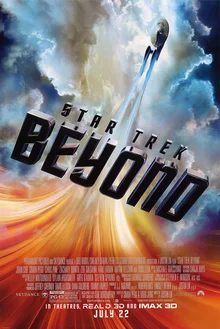
Star Trek Beyond (2016)

Mac Boyle February 17, 2019

Director: Justin Lin

Cast: Chris Pine, Zachary Quinto, Zoe Saldana, Idris Elba

Have I Seen it Before: Once again. Unless it’s a brand-spanking new release, it’s a safe bet that I’ve seen a Star Trek film before.

Did I Like It: It’s almost like they finally took every complaint I had about the previous two films (more the second than the first) and incorporated them into a new film. This is that film.

Here’s a deep, dark secret about Star Trek, especially anything having to do with any version of Kirk and company, the original crew. Everyone says it is about lofty ideals and political parables. But really, truly, it is an adventure series. It works best when its an adventure story. 

Star Trek II: The Wrath of Khan (1982) goes back to the purest distillation of the franchise and presents Horatio Hornblower in space. Certainly, you get something like various episodes of the TV series, or both Star Trek IV: The Voyage Home (1986) and Star Trek VI: The Undiscovered Country (1991) that have deeper ideas, but those ideas are fully developed. This film’s predecessor, Star Trek Into Darkness (2013), tries to reach for those lofty ideas, but half-bakes some kind of post 9/11 mush.

This film doesn’t have that problem. There’s a hint of a dissertation as to whether the Federation’s ideals of peace and unity, but here are the elements that keep the film together. There’s a bad guy who wants to do bad things. The only people that can stop them are the crew of the USS Enterprise. they will have a hard time repelling this threat.

That’s all you need, really, and this film doesn’t need anything more than the basics. Those lofty ideals should really be reserved for Nicholas Meyer, honestly. This film is far more engagingly Star Trek than any of the previous Abrams-involved ones. It also has the unusual distinction of not having any scenes take place on or in orbit of Earth (Star Trek: Insurrection (1998) is the only other entry in the film series to do this), and that is far more true to the reality of Star Trek than the alternative.

At the time of this writing, it is entirely possible that the “Kelvin” series will stay a trilogy. Time will tell, but as a finale, it works in remarkably subtle ways. The Beastie Boys are back to my undying chagrin, but at least here it has some kind of story-based reason for existing in Roddenberry’s future, and even kind-of-sort-of makes its original existence in Star Trek (2009) as set-up for this eventual payoff. The angry young men that Kirk (Pine) and Spock (Quinto) were when we first met them have settled into the people they are supposed to be, and are no longer bound by the prime universe that preceded them. If they do return, then it would be nice to see them just inhabit the characters, now that the development is complete.

Tags star trek beyond (2016), star trek film series, justin lin, Chris Pine, zachary quinto, zoe saldana, idris elba
Comment

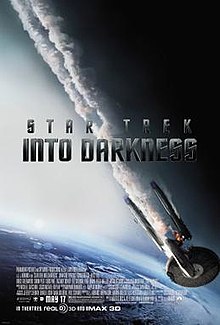
Star Trek Into Darkness (2013)

Mac Boyle February 10, 2019

Director: J.J. Abrams

Cast: Chris Pine, Zachary Quinto, Bruce Greenwood, and that great latin lover, Benedict Cumberbatch.

Have I Seen it Before: Since 1994, it is reasonable to assume that I’ve been there for every Star Trek film on opening weekend.

Did I Like It: Folks, I really want to enjoy every Star Trek film. I want to. And yet…

It’s difficult to try and criticize this film without taking a deep dive into my long-standing Trek fandom…

So here I go criticizing from that perspective:

The opening scene is such a complete and total violation of the Prime Directive in every way, shape and form. How Kirk (Pine) is not arrested and sent to a prison colony for life twenty minutes into this movie is beyond me.

They keep referring to the transwarp beaming equation that Scotty (Simon Pegg) “developed” in the original film. That was supposed to allow people to beam onto a ship traveling away from you at warp speed. It has nothing to do with beaming people to a planet in a completely different sector of space many light years away. Also, not for nothing, the effective development of that technology negates the need for starships at all, and pretty much nullifies the entire concept of Star Trek. Not great, all things considered.

The fact that Leonard Nimoy, in his final performance as Spock Prime, doesn’t argue with McCoy (Karl Urban) is a missed opportunity that will never present itself again.


Maybe one can try to make an argument that the film has a certain energy that someone who isn’t steeped in the lore of this franchise might find entertaining, but in my best attempt to try and see this film from that perspective, I just can’t make it happen. This movie has been unleashed on the public for nearly six years. Can anyone explain to me what it is actually about, beyond a tame studio-watered down semi-parable for the post 9/11 world? 

Even the stakes are much lower here. In Star Trek (2009), Nero threatens the entirety of planet Earth, after proving that he is a real threat by destroying the planet Vulcan. Here, Khan (Benedict Cumberbatch) has a plan. I’m still not entirely sure what it is, but at the end of it, a large ship crashes into San Francisco. 

Let’s talk about Khan, and for that matter, Khan, while we’re at it. The casting of the whitest man in all of time and space to succeed a decidedly non-white hispanic actor playing a man of Indian decent is a little… Well, it’s certainly something. The error is retconned by a four-part comic series published after the movie was released, but it doesn’t bode well for the film itself if you have to have the ancillary material to make heads or tails out of it. Also, the reversal of roles merely for a rehash of the far, far superior Wrath of Khan (1982) is lame in extreme.

Also, his blood wasn’t some sort of fountain of youth. Just saying.

It’s flimsy, and cheap in its writing, and that’s pretty impressive when you could say that about a lot of the big budget action far hoisted upon us. I cannot help but think that Abrams was eyeing adventures in another galaxy, far, far away and didn’t have his eyes on the prize here, and it became clear that his various lieutenants don’t have his same skill.

For some reason I want to rate this film higher than the generally accepted worst films in the franchise (either Star Trek V: The Final Frontier (1989) or Star Trek: Nemesis (2002), depending on your particular taste), but on this particular viewing I don’t think I can go light on it. This may be the worst Trek film…

Or it’s as bad as Nemesis, not worse. I think I’ll go with that much. Worse than Nemesis feels like a stretch. 

Tags star trek into darkness (2013), star trek film series, jj abrams, Chris Pine, zachary quinto, zoe saldana, benedict cumberbatch
Comment
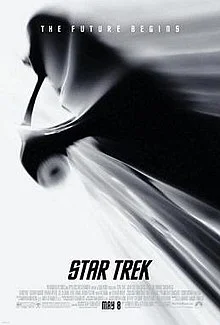
220px-Startrekposter.jpg

Star Trek (2009)

Mac Boyle February 9, 2019

Director: J.J. Abrams

Cast: Chris Pine, Zachary Quntio, Zoe Saldana, and keeping the whole thing together, the late, great Leonard Nimoy

Have I Seen it Before: I saw it four times in the theater. 

Did I Like It: It may have launched some irritating things (including its own 2013 sequel), but it is hard to deny this film its charms, or, more importantly, the moments where it absolutely sings.

The last ten years or so should be a difficult time for action-adventure movies like those that make up the Star Trek series. They aren’t about anything, other than the thin connective tissue that will propel characters from explosion to explosion. So that this first attempt to relaunch the franchise after the petering out experience by Nemesis (2002) and the then most-recent series, Enterprise, does something incredibly smart. It presents the space opera as coming of age story. Sure, it’s not the loft ambition of a Horatio Hornblower story, or even a parable about Chernobyl in space, but telling the tale of James T. Kirk (Pine) and Spock (Quinto), Angry Young Men, is certainly a good starting out point for the film.

And it mostly works! There are things that serve to annoy. The lens flares are ubiquitous, but commentary about them has become far more irritating than the flares could ever have hoped to be. The decision to shot any utilitarian section of a starship in a brewery has never made sense to me. The Beastie Boy-laden scene where the spunky tween-who-would be Captain Kirk (Jimmy Bennett) faces off with Robocop and gravity remains one of the most irritating scenes in recent memory, compounded by the unassailable reality that it lifts right out of the movie. Not many people talk about how there’s some serious post-production jiggery pokery that leaves the bad guys waiting around for twenty-five years with nothing to do, and I will opt not to go into it much further here.

I could go on. Honestly, it should be a little bit harder to beat the Kobayashi Maru test, even if you have reprogrammed the simulator. But the parts that do work far outweigh the nitpicks. The film is cast perfectly, with the new cast bringing new energy to roles we already think we know. Karl Urban might (and I stress, might) have been more born to play the role than even Deforrest Kelley. The mini-tragedy at the beginning of the movie heralds the coming of Chris Hemsworth, undeniable movie star and latches the film to real emotions, even during those scenes and plot holes I can’t abide. 

And there is one moment, and one spark of performance, that makes this film—and, indeed, the entire “Kelvin” series—work on the whole. It is the first moment in which Kirk encounters Spock Prime (Nimoy). The elder Spock takes one look at this brash upstart and says, haunted by everything we as the audience has already seen. “James T. Kirk…I have been, and always shall be, your friend.” In that moment, I believe Pine is Kirk, Quinto is Spock, and on and on. It’s a moment the film absolutely depends on, and Nimoy nails it with such subtlety, that it’s hard not to marvel at the moment with every repeat viewing.

Tags star trek (2009), star trek film series, jj abrams, Chris Pine, zachary quinto, zoe saldana, leonard nimoy
Comment
220px-Star_Trek_VI-poster.png

Star Trek VI: The Undiscovered Country (1991)

Mac Boyle January 1, 2019

Director: Nicholas Meyer

Cast: William Shatner, Leonard Nimoy, DeForrest Kelley, Kevin Spacey Christopher Plummer*

Have I Seen it Before: Well, this is the first film in the Star Trek series I’ve reviewed, so unless we happen to be dealing with a new release, it’s a pretty safe bet that I’ve seen it before.

Did I Like It: It might objectively be the best Star Trek film of all time. Does that mean it is the best Star Trek film of all time, or even the best Star Trek film directed by Nicholas Meyer? Well, that’s a different story.

I’ve written a couple of times in these reviews about timelessness in films. It’s appropriate to broach the subject of the film, because the notion was put into my head by Meyer, and he perfects the reach for a timeless quality in this film. Beyond a few scant special effects that might have been a little ahead of their time, there’s not really an aspect of this movie, from the music, to the cinematography, all the way to the hair styles, there is almost nothing about this film that restricts it to being made in the early 1990s. It’s a marvel to behold, and a phenomenon that Meyer’s other great space-opera Star Trek II: The Wrath of Khan (1982) can’t even claim, even though that is one of my all-time top five movies.

Even the one element that threatens to make the film strictly of its time manages to transcend. Clearly a parable about the end of the Soviet Union (with just a pinch of Watergate-esque intrigue thrown in for good measure), the film is clearly commenting about the end of the 80s and the beginning the 90s. The Klingons have their own version of Chernobyl, unrelenting hostilities are coming to an unfathomable end, and the old guard is to varying degrees uncomfortable with the forthcoming future, or the titular undiscovered country**. But I think it may be a byproduct of living in a political era that could—politely—called “interesting” that the macro machinations of the galaxy here can’t help but feel relevant to the here and now. This is when Star Trek often works the best, and it shows.


* Could you imagine? Don’t. #2017jokesfiresale

** Which is a strange title for this film, if treated to any further scrutiny. The Wrath of Khan was originally called The Undiscovered Country, and as it is an allusion to Hamlet, and specifically death, it feels more appropriate to that film. Here, it is essentially saying that the sometime arduous road to peace only ends in death. Ominous. Mad ominous, folks. 

Tags star trek vi: the undiscovered country, star trek film series, nicholas meyer, william shatner, leonard nimoy, deforrest kelley, christopher plummer
Comment

Powered by Squarespace

Party Now, Apocalypse Later Industries

Where creativity went when it said it was going out for cigarettes.

Where creativity went when it said it was going out for cigarettes.