Party Now, Apocalypse Later Industries

Where creativity went when it said it was going out for cigarettes.
  • Home
  • BOOKS
    • THE ONCE AND FUTURE ORSON WELLES
    • IF ANY OF THESE STORIES GOES OVER 1000 WORDS...
    • ORSON WELLES OF MARS
    • THE DEVIL LIVES IN BEVERLY HILLS
    • A LOSS FOR NORMALCY
    • RIGHT - A NOVEL OF POLITICS
  • PODCASTS
    • Beyond the Cabin in the Woods
    • THE HOLODECK IS BROKEN
    • THE FOURTH WALL
    • As The Myth Turns
    • FRIENDIBALS! - TWO FRIENDS TALKING ABOUT HANNIBAL LECTER
    • DISORGANIZED! A Criminal Minds Podcast
  • MOVIE REVIEWS
  • BLOGS AND MORE
    • Bloggy B Bloggington III, DDS
    • THE HOLODECK IS BROKEN BLOG
    • REALLY GOOD MAN!
  • Home
    • THE ONCE AND FUTURE ORSON WELLES
    • IF ANY OF THESE STORIES GOES OVER 1000 WORDS...
    • ORSON WELLES OF MARS
    • THE DEVIL LIVES IN BEVERLY HILLS
    • A LOSS FOR NORMALCY
    • RIGHT - A NOVEL OF POLITICS
    • Beyond the Cabin in the Woods
    • THE HOLODECK IS BROKEN
    • THE FOURTH WALL
    • As The Myth Turns
    • FRIENDIBALS! - TWO FRIENDS TALKING ABOUT HANNIBAL LECTER
    • DISORGANIZED! A Criminal Minds Podcast
  • MOVIE REVIEWS
    • Bloggy B Bloggington III, DDS
    • THE HOLODECK IS BROKEN BLOG
    • REALLY GOOD MAN!

A Blog About Watching Movies (AKA a Blog in Search of a Better Title)

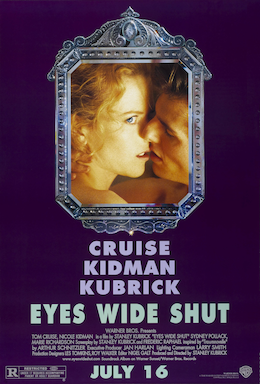
Eyes Wide Shut (1999)

Mac Boyle August 20, 2024

Director: Stanley Kubrick

Cast: Tom Cruise, Nicole Kidman, Sydney Pollack, Maria Richardson

Have I Seen it Before: Yeah. I was probably in my twenties or even younger, and I felt like how I felt about a lot of Kubrick films on first viewing. I just didn’t get it. I would be a little leery of any teenager or person in their twenties why got anything out of this film other than nudity up to and including Kidman.

I was compelled to come back to the film when my festival screener duties* drifted into an inexplicable new adaptation of Schnitzler’s original novel. All it did was want me to re-visit the Kubrick of it all.

Did I Like It: It’s immaculately made—naturally—and that’s all the more mystifying when one thinks that Kubrick couldn’t possible have been in the best of health when the entire production was going through the Sisyphean task of a year-plus shoot. It’s frank and unblinking in the things it depicts, with several moments legitimately feeling like we got a peak into Cruise and Kidman’s marriage. I can only imagine what putting those moments—both banal and intense—on display did to them.

But we can talk about the sex—also both banal and intense—in the film for days, but it is only a surface reading. The sex is incidental. I’m struck in this viewing by the dynamic between Harford (Cruise) and his old medical school chum Nick Nightingale (Todd Field). You might have one read from their scenes together, but Eyes Wide Shut isn’t about those surface readings. I tend to think that if Bill hadn’t met someone at that party who rejected everything he himself had done to have a comfortable, stable life, he probably wouldn’t have gotten in nearly as much trouble as he did.

You might think I’m reading the movie wrong. I’m not, but then again it’s very hard to read a Kubrick film entirely wrong.

*No, I’m not saying which festival. You just keep submitting.

Tags eyes wide shut (1999), stanley kubrick, tom cruise, nicole kidman, sydney pollack, maria richardson
Comment

Dr. Strangelove or: How I Learned to Stop Worrying and Love the Bomb (1964)

Mac Boyle August 4, 2024

Director: Stanley Kubrick

Cast: Peter Sellers, George C. Scott, Sterling Hayden, Keenan Wynn

Have I Seen it Before: Oh, sure.

Did I Like It: Your mileage on this film is going to largely depend on the era in which you watch it. As a diligent movie freak in my younger (and now older) years, I made a point of watching it. In the early 2000s, the threats of the last century had already seemed quaint, and so, too, did the movie itself.

But now?

With a world swinging wildly between the abjectly horrific and the sublimely absurd (or is it the other way around?), the jokes hit quite a bit harder. That might be a bit unfair, and risks drifting into that same nostalgic way of thinking that insists that the world was a simpler place when we were younger. It isn’t so much that I wasn’t able to get into the film in the year 2000, it’s probably more that the world isn’t crazy enough for a fifteen year old to really enjoy the potshot.

But Kubrick isn’t a comic filmmaker at his core. Judging the film just by the standard of how much it makes one laugh is only part of the equation. Normally immaculate in each of his films, Kubrick lets the film surrounding this funhouse mirror reflection of the world in 1964. The expansive war room brought to life by Ken Adam—you’ll see his aesthetic all over the early Bond films—contrasts with the cramped spaces of the B-52 bomber. Visually, it keeps one interested, but all stays of a piece with each other. Aurally, too, the War Room echoes cavernously with every shout while the bomber clicks and whirrs with every mechanized horror they implement. Kubrick never cedes control over his films, even when what is being displayed is pointedly chaotic.

Tags dr strangelove (1964), stanley kubrick, peter sellers, george c scott, sterling hayden, keenan wynn
Comment
A7FA56EF-5E3D-4216-9A78-E2C66508B5A9.jpeg

Full Metal Jacket (1987)

Mac Boyle December 13, 2020

Director: Stanley Kubrick

Cast: Matthew Modine, Vincent D’Onofrio, R. Lee Ermey, Adam Baldwin

Have I Seen it Before: Never. I know, I know...

Did I Like It: Any criticism of a Kubrick movie has a certain limitation right out of the gate. There is likely no greater director from an aesthetic point of view. Even if someone has the gall to dismiss any of his movies as boring—a critique often leveled at 2001: A Space Odyssey (1968)—no one can say his movies look bad. This film is no exception. His pure photographer’s eye is incapable of being distracted from his intended purpose. If you haven’t gotten around to see any of his films—as I had with this one—and profess to love cinema, then you probably better fill out the gaps in your experience.

But there are a few things that strike me about the film as it proceeds.

Normally, I would be very dim on a film which spends as much time on a first act that doesn’t really serve the story later on, but once again Kubrick’s artistry is such that I’d be willing to give him a break on almost anything. You can swing your arms and hit films that depict the insanity and absurdity of war, but few are willing to drive home how foolish something like basic training can become.

I was surprised by how much popular music Kubrick used in the film, as I would have assumed it would be filed to the brim with classical selections. Then again, if Kubrick simply duplicated his choice from 2001 and A Clockwork Orange (1971), that wouldn’t be worth his time or mine.

I’m also struck by a phenomenon unique to his films, and its a thought that flies in the face of how I’ve viewed his films in the past, especially 2001. He shoots in an aspect ratio that would actually maintain—more than any other films from the era—the experience as much as possible when viewed on televisions before the ubiquity of widescreen sets. There is no need to Pan and Scan his films. It’s staggering that he could both work to create an experience that simply must be experienced on the largest screen possible and could be viewed on a crappy VHS copy without having any of the frame summarily lopped off.

Tags full metal jacket (1987), stanley kubrick, matthew modine, vincent d'onofrio, r lee ermey, adam baldwin
Comment
220px-2001_A_Space_Odyssey_(1968).png

2001: A Space Odyssey (1968)

Mac Boyle August 24, 2018

Director: Stanley Kubrick

Cast: Keir Dullea, Gary Lockwood, Douglas Rain, William Sylvester, and Star Child (who looks at us from the cosmos and judges us with his big, second-hand Dullea eyes)

Have I Seen it Before: Can one truly see this movie? Is it more important to experience it…? These are the questions I have now. The answer is, yes, it must be experienced. So there. One less question.

Did I Like It: Over the years, I have to come to appreciate the movie, but until now I don’t think I ever truly got it.


We are all Star Child.

Wait, wait. Come back. I’m going somewhere with this.

I’ve often felt that my own movie-watching experience has been wildly warped by never seeing a vast majority of films in the way they were intended to be viewed—on the largest screen possible, and with a crowd engaged in a shared experience. Indeed, until the wide availability of DVDs in the mid-90s, VHS probably ruined most movies before they had a chance to breathe. I first saw Blade Runner (1982) on a Blockbuster-rental cassette that had already lived past its usefulness before I pressed play, and I don’t think I’ve yet to properly appreciate the movie for what it is. Movies like Independence Day (1996) or Armageddon (1998) are especially vulnerable to showing their flaws when stripped down for presentation on a TV. Even Star Wars (1977) was a wildly different movie seeing it in the theater in its 1997 special edition than it was over dozens of times on tape. 

When I first saw 2001 as a kid, I similarly didn’t get it. In fact, I kinda hated it. Nothing happens for long stretches of time, and that intermission? Give me a break. In those intervening years, I read the concurrently-developed novel by Arthur C. Clarke and gain at least a semblance of understanding as to what Kubrick was showing us. As I grow older still, I can appreciate that an array of special effects—that were then still in very much a beta-version back then—still hold up today.

But until the planets appeared to align in the opening titles, I became a believer. This movie was never meant to be merely watched, it was meant to be experienced. Everything has been a lame pretender to the intent of Kubrick and co.

The movie is far from boring, as is often the case of criticism leveled at it. It just hasn’t been experienced correctly. Even the intermission—maddening on spec for a not quite 2 1/2 hours in length—the glowing ethereal quality of the black screen didn’t indicate the absence of material, but instead (I shit you not) almost resembled a monolith.

Kubrick knew exactly what he was doing. That being said, he is a filmmaker in every sense of the word. He’s never been terribly interested in working as a dramatist; if he had, he would have eschewed movies for the stage. Thus, the few and far between scenes that involve people talking to one another are probably the least interesting. That’s okay, because there’s a good forty-five minutes (I think, I didn’t actually time the thing) before any human as we understand them speaks. By the time Dave Bowman (Kier Dullea approaches Jupiter and takes his trip beyond the infinite, I nearly had a panic attack form the breathtaking images presented to me in such a new fashion. 

I’m a believer in this movie now, but it must be seen in the proper context.

If you happen to read this while the movie is still in its limited re-release, or if by some miracle you have the opportunity to see it in 70MM in one of the few venues equipped for such an exhibition, please go. Honestly, I don’t think you’ve really seen this movie yet, even if you’ve watched it a dozen times.

My only complaint? To this day, I don’t understand why Heywood Floyd (William Sylvester)—a reportedly experienced space traveller stares at the instructions for the zero-gravity toilet for what seems like an entire reel of film?Minor quibble. Do with it what you will.
Tags 2001: A Space Odyssey, stanley kubrick, keir dullea, gary lockwood, starchild, 1968, 1960s
Comment
220px-The_Shining_(1980).png

The Shining (1980)

Mac Boyle August 19, 2018

Director: Stanley Kubrick

Cast: Jack Nicholson, Shelley Duvall, Danny Lloyd, Scatman Crothers

Have I Seen it Before: I’ve always been the watcher of this movie…

Did I Like It: What’s not to like? Yes, Mr. King, we’ve already heard from you.

Before making films, Stanley Kubrick was one of the premiere still photographers in the world. As a filmmaker, he never seemed particularly interested in being a dramatist, and stayed firmly entrenched in his roots. Thus, as a director he ends up being more of an impressionist, if one can be such and still make studio pictures. Thus, the film is a Rorschach test, providing any watcher with exactly what they want to see (see Room 237 (2012)). And thus, it’s only partially an adaptation of the original King novel.

Kubrick, though fills his movie with general dread for as long as he can, and then erupts the film King throughout his work has been very interested in mythology, perhaps at the expense of actual horror. Kubrick just wants us to feel the horror, and for my money, he mostly succeeds, while at the same time giving us far more (although perhaps not as much as some others would have us believe) to chew on.

Much has been made of King’s displeasure with the book, and beyond the reality that Kubrick’s movie is not a faithful adaptation, I just don’t see it. He has—at times—complained about how he believed Jack Torrance as played by Jack Nicholson appears to be a madman from the first frame, making his transformation to axe-wielding maniac more of a tragedy. Aside from a simmering hostility that Nicholson seems to have as part and parcel of his film persona, I just don’t quite see it. 

King’s book is a fine book, but not his best. Whereas with the film—with the sheer depth of analysis that can be made about the movie is staggering—is a far more memorable experience.

Tags the shining, stanley kubrick, jack nicholson, shelley duvall, scatman crothers, 1980, 1980s
Comment

Powered by Squarespace

Party Now, Apocalypse Later Industries

Where creativity went when it said it was going out for cigarettes.

Where creativity went when it said it was going out for cigarettes.