Party Now, Apocalypse Later Industries

Where creativity went when it said it was going out for cigarettes.
  • Home
  • BOOKS
    • THE ONCE AND FUTURE ORSON WELLES
    • IF ANY OF THESE STORIES GOES OVER 1000 WORDS...
    • ORSON WELLES OF MARS
    • THE DEVIL LIVES IN BEVERLY HILLS
    • A LOSS FOR NORMALCY
    • RIGHT - A NOVEL OF POLITICS
  • PODCASTS
    • Beyond the Cabin in the Woods
    • THE HOLODECK IS BROKEN
    • THE FOURTH WALL
    • As The Myth Turns
    • FRIENDIBALS! - TWO FRIENDS TALKING ABOUT HANNIBAL LECTER
    • DISORGANIZED! A Criminal Minds Podcast
  • MOVIE REVIEWS
  • BLOGS AND MORE
    • Bloggy B Bloggington III, DDS
    • THE HOLODECK IS BROKEN BLOG
    • REALLY GOOD MAN!
  • Home
    • THE ONCE AND FUTURE ORSON WELLES
    • IF ANY OF THESE STORIES GOES OVER 1000 WORDS...
    • ORSON WELLES OF MARS
    • THE DEVIL LIVES IN BEVERLY HILLS
    • A LOSS FOR NORMALCY
    • RIGHT - A NOVEL OF POLITICS
    • Beyond the Cabin in the Woods
    • THE HOLODECK IS BROKEN
    • THE FOURTH WALL
    • As The Myth Turns
    • FRIENDIBALS! - TWO FRIENDS TALKING ABOUT HANNIBAL LECTER
    • DISORGANIZED! A Criminal Minds Podcast
  • MOVIE REVIEWS
    • Bloggy B Bloggington III, DDS
    • THE HOLODECK IS BROKEN BLOG
    • REALLY GOOD MAN!

A Blog About Watching Movies (AKA a Blog in Search of a Better Title)

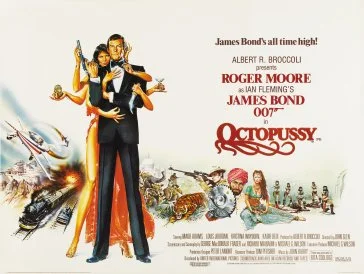
Octopussy (1983)

Mac Boyle January 2, 2025

Director: John Glen

Cast: Roger Moore, Maud Adams, Louis Jourdan, Kristina Wayborn

Have/ I Seen it Before: Sure. TBS, the 90s. That whole bit. Felt a little bit weird writing down the title on a VHS label, but that’s how one started to amass their movie collection with a $5.00 allowance.

I sometimes wonder if re-watching some of these films on those VHS recordings might have a little charm to them. Would it be a delight to take a bathroom break in the middle of this film to see a commercial for the Bigfoot Pizza and In The Mouth of Madness (1995). I may never again see a movie that way again. I’m oddly wistful about that in this moment.

Did I Like It: I’m stalling, aren’t I? There’s a lot of this film that works. Moore in his element, doing switcheroos on Fabregé and making googly eyes at a woman far classier than him. There are several mildly funny digs at the state of the competition—namely Never Say Never Again (1983)—although I may have been reading too much into the “REAL BOND” sign oddly hanging over Moore’s head at one point, and it seems like they’re using about twenty percent more of the Monty Norman theme than the average.

Then there’s the clown thing. I’ve made no secret of how little I think of shooting Ian Fleming’s borderline sociopathic spy into space. It was such a dimly-considered chase of where the movies were in that moment. But in this one, the man gets out of a sticky situation with a nuclear bomb by dressing as a god damned clown. In Moonraker (1979) he tries to take a page out of Luke Skywalker. Here, for no other reason than Moore is a little bored in the role*, decides to start saving the world using Charlie Chaplin’s playbook.

I do dislike that more than the space thing. Sorry, Sir Roger.

*And might have been well-advised to bow-out after the far superior For Your Eyes Only (1981).

Tags octopussy (1983), john glen, roger moore, maud adams, louis jourdan, kristina wayborn, james bond series
Comment

Moonraker (1979)

Mac Boyle December 16, 2024

Director: Lewis Gilbert


Cast: Roger Moore, Lois Chiles, Michael Lonsdale, Richard Kiel


Have I Seen It Before: Yes. Yes, I have. Must I say more?


I just checked with the proprietor of the site and yes, apparently, I must say more.


I must have first seen it during a TBS marathon of the films, which I dutifully recorded on VHS, and clearly didn’t think much of it even back in the far-flung 90s because my strongest recollection of the film is that I labeled that VHS tape (I think I used an LP tape) along with License to Kill (1989) “Moonwaker.” Thirty years later, I still think that’s a better title. All of eleven years old, and I’ve already got notes for improvements.


Did I Like It: Where to begin? Let’s start with the positive. Almost none of the Bond films have missed the mark with their pre-title sequence. And the skydiving duel between Bond (Moore, looking as if he’s just about ready to check out of the role, despite the fact that he’s going to do three more) and Jaws (Kiel, more on him later) is about as good as any of Moore’s openings.


Now that we have that out of the way. Bond is in space. Space. Spaaace. Fleming would rise from the grave and have a heart attack all over again. And the only reason Bond becomes Britain’s first man in space, is because Star Wars – Episode IV: A New Hope (1977) and Close Encounters of the Third Kind (1977)* made huge money and there are moments where Cubby Broccoli had all the creativity of a mimicking parrot.


Some might applaud the visuals during the film’s inexplicable third act, but aside from Ken Adam’s always delightful set design, all this film can offer is a barely warmed over riff on Star Wars. That film was a symphony of sounds that still dominates genre filmmaking, but the laser fire on display here is one step removed from someone dubbing in “Pew!” sounds.


And then there’s Jaws. One of the most menacing villains in the movies not only finds love (I’m not opposed to it) but it turns him into an ally because… well, the film has to have some kind of an ending, right?


The rest of the film is a humdrum Bond adventure, painted by largely by numbers. Where it isn’t baffling bad, it’s content to be middle-quality. I might be more mad about that than anything else.


But you want to know what really struck me on this viewing? I look at the sight of a megalomaniacal industrialist in love with rockets and space travel, bedraggled by what he sees as humanity’s twilight, which will only lead him to be the MC for the apocalypse. And then I start watching the movie. It’s not possible that old what’s his name saw this movie as a child and decided that was all he ever wanted to be… Right? It could be, though. What have we done?


*Urban legend insists that Spielberg himself campaigned hard to direct this one, only to get nowhere with EON. Could you imagine? They’d have reined him in and it would have been just as much of a disaster, but he might have been spared the indignity of 1941 (1979).

Tags moonraker (1979), james bond series, lewis gilbert, roger moore, lois chiles, michael lonsdale, richard kiel
Comment

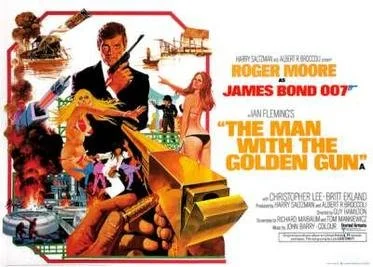
The Man With the Golden Gun (1974)

Mac Boyle December 15, 2024

Director: Guy Hamilton


Cast: Roger Moore, Christopher Lee, Britt Ekland, Maud Adams


Have I Seen It Before: Oh, sure. Oddly enough, I think this may be the film in the canon I’ve seen the least. (Octopussy (1983) may be in close competition).


Did I Like It: I’m honestly not sure why that’s the case, as I tend to be a bit of a contrarian about Moore’s time in the tuxedo and Walther PPK. This is almost universally reviled as Moore’s worst at-bat (usually uttered in the same breath with A View To A Kill (1985).


But I really like (well… sort of like) A View To A Kill, and dare I say I liked large swaths of this one, too. It might be the villain at the center of it all. Christophers Walken and Lee were born to play Bond villains, and acquit themselves well. Throw in the fact that Lee’s Scaramanga has a ruthless, simple ambition and plan (at least in the first half of the film) that makes it one of the more solid Fleming adaptations starring Moore.


Even when the film settles into the old hoary Bond cliches, it’s not all bad. There’s a Macguffin of a device that makes solar power work which is somehow simultaneously silly on its own and so of-the-moment that it must have felt passe by the time The Spy Who Loved Me (1977) arrived in theaters. I may owe Tomorrow Never Dies (1997) an apology for the side-eye I gave it when I remembered that the whole plot hinged on a GPS device.


The theme song, sung by Lulu and with music by the Bond music GOAT John Barry is dismissed so perpetually (even by Barry himself) but after having the other Bond themes on regular re-play, I found it one oddly fresh again. Sure, it’s lyrics are a listing of various plot elements, but that can be fun, too. If we didn’t have this title theme, we might not have had the various rap tracks recounting movie plots throughout the 80s and 90s. Lulu walked so Partners in Kryme could run. If you know, you know.


I’m honestly not entirely sure why both View and this one are consistently ranked at the bottom of Moore’s efforts.


Then I see Sherriff J.W. Pepper (Clifton James). Again, apparently. Where he might have made sense in Live and Let Die (1973) (I’m being generous here) it’s a real bummer to find him becoming not only a recurring character here, but just a little bit of a partner in crime (or kryme) for a moment. I can’t explain away Pepper, but I’ll be damned if I didn’t crack a smile when his wife (Jay Sidow) wants to buy a Hong Kong Elephant trinket and he grumbles “Elephants! We’re Democrats, Maybelle.”

I didn’t think I would be this forgiving as I march through Moore’s films. Could this possibly hold up? Oh, no… (checks notes) I’m going to have to review Moonraker (1979) now, aren’t I?

Tags the man with the golden gun (1974), james bond series, guy hamilton, roger moore, christopher lee, britt ekland, maud adams
Comment
220px-Live_and_Let_Die-_UK_cinema_poster.jpg

Live and Let Die (1973)

Mac Boyle April 15, 2020

Director: Guy Hamilton


Cast: Roger Moore, Yaphet Cotto, Jane Seymour, Geoffrey Holder


Have I Seen it Before: Yeah…


Did I Like It: And so, we renew my vow to not be all that into the Roger Moore reign behind the wheel of the Aston Martin from Q Branch (or, as he so often inexplicably drives, a Lotus Esprit).


Things start off on a rocky note. One wants to give credit to Moore for making the dauntingly bold gambit of taking over for Sean Connery, especially when the last fellow to try that has spent most of the last fifty years pilloried for his efforts. But when the assignment from M comes not during a meeting at MI-6. This precludes the possibility of this new Bond having his moment with Desmond Llewellyn’s Q, which makes it hard to accept this as a Bond film at all, even if the gun barrel sequence helps. But far more unsettling is tiny little farce that plays out while Bond is trying to keep M (Bernard Lee) from realizing that he has a woman over. It’s so, un-Bondian. The literary Bond or even Connery’s Bond (and let’s get real, Lazenby wouldn’t give a shit, either) wouldn’t be so coy about relations with a woman. Maybe The Saint would be that precious, and that’s probably the problem.


But let’s talk about Racism! The film makes that fatal flaw of several of Moore’s later outings by trying to imitate another genre, in this case the blaxploitation films of the 1970s. But when the film is exclusive authored by white filmmakers, all we get here are the trappings, but none of the authentic style. 


But more importantly, let’s talk about sexism! Now that may seem like a strange criticism for a Bond movie. If I wasn’t budgeting for a certain amount of sexism, I probably should have watched a film from some other series. But every black man seems to be cunning, when the few scant women of color—mainly Rosie Carver (Gloria Hendry)—screech and faint their way through the movie. I can roll my eyes at the Stacy Suttons and Christmas Joneses of the world as much as the next guy, as their faux over capability beggars all believability, but a little bit of agency wouldn’t hurt, especially when by this point the series had a plenty of relatively self-possessed heroines. Even Jane Seymour has more of a certain serene aptitude about her.


That whole penultimate act, though… And that’s before I even approach the unslightly beginning of what would become the epic tragedy that is Sherriff J.W. Pepper (Clifton James). Roaring through the marshes of Louisiana is not exactly the Baccarat (or Poker) table at the Royale, but a Bond movie needs to be a little more exotic than that. Even Diamonds Are Forever (1971) brought Bond down to the banal world of the United States, but at least had the good sense of placing him in Las Vegas, a place I might believe to see a character like Bond. And here, Bond lifts himself out of his dilemma with Mr. Big’s (Cotto) henchmen with all of the lethality of Bugs Bunny.


Your individual feelings about this film will likely be tied directly to how you feel about Moore as Bond. Thus, if he’s your man with the License To Kill, then this is likely to be a highlight. For me, it’s just a portent of far worse things to come.

Tags live and let die (1973), james bond series, guy hamilton, roger moore, yaphet kotto, jane seymour, geoffrey holder
Comment
220px-For_Your_Eyes_Only_-_UK_cinema_poster.jpg

For Your Eyes Only (1981)

Mac Boyle March 28, 2020

Director: John Glen 


Cast: Roger Moore, Carole Bouquet, Topol, Julian Glover


Have I Seen it Before: Yes... There’s a stretch of time in the mid 1990s where I would watch and record any Bond film that appeared on TNT. Without those marathons, I might never have viewed some of the middle-era Roger Moore films.


Did I Like It: Now comes the part in my review of a Roger Moore Bond film where I talk about how I don’t care for him as Bond. He’s too funny, and in that preening sort of way where he thinks he’s pretty funny, too. Sort of like Dane Cook with a vodka martini and a slightly less misogynistic misanthropy. I loathe Moonraker (1979) for feeling the need to chase the Star Wars (1977) and I think his best entry is the one everyone seems to shrug at, his final entry, A View to a Kill (1985), mainly because Moore plays against type. As such, For Your Eyes Only was never in my pantheon of go-to entries to re-watch.


As I continue to read through Nobody Does It Better: The Complete, Uncensored, Unauthorized History of James Bond I was surprised to hear everyone talk about this entry as if it was a return to the form of more Fleming-esque source material, like From Russia With Love (1963) or On Her Majesty’s Secret Service (1969).


Then I re-ran my DVD, and I’ll be damned. This is the one where the pre-credits sequence has Bond getting his long overdue revenge on a maniacal villain complete with pet cat. We all know the fiend is Blofeld, but because the morass that became the rights to Thunderball and the larger SMERSH/SPECTRE lore, he goes unnamed. It’s a pretty good beginning to the movie, especially when its as close to coming up against Blofeld as Moore ever got.


The rest of the film is a smaller story (far smaller than the ridiculous previous entry, Moonraker) and that’s a welcome change for Moore. I do get the same sense of ennui that I feel during the last half of nearly every Moore entry (and for that matter, Brosnan as well), but even Moore’s penchant for humor worked better than it does at other times. I’ll be damned if that last moment with Margaret Thatcher talking to a parrot didn’t having me laughing, and that typing the phrase “Margaret Thatcher talking to a parrot” didn’t have me laughing all over again. So, good job, Roger Moore-era Bond. You got me.


Am I starting to like Roger Moore’s entries? Is that what happens when people get older? Will I start thinking Moonraker is actually worth my time? Surely not.

Tags for your eyes only (1981), james bond series, john glen, roger moore, carole bouquet, topol, julian glover
Comment
220px-The_Spy_Who_Loved_Me_(UK_cinema_poster).jpg

The Spy Who Loved Me (1977)

Mac Boyle March 25, 2020

Director: Lewis Gilbert

Cast: Roger Moore, Barbara Bach, Richard Kiel, Curd Jürgens

Have I Seen It Before?: Yes.

Did I like it?: I’ve been reading Nobody Does It Better: The Complete Uncensored, Unauthorized Oral History of James Bond lately, thus increasing my craving for a bit of that old EON touch. I could have gone for one of the films I’ve watched a number of times like From Russia With Love (1963) or even one I’ve already reviewed like Goldeneye (1995), but I thought I’d take a deep dive into the most universally loved of Roger Moore’s entries, instead.

I’ve never been a big fan of Moore in the role. He shed too many of the trappings originally associated with the character as created by Ian Fleming. In fact, of all his entries, I’m most fond of A View To A Kill (1985), Moore’s last entry which most fans and even the actor himself view as unusually dour and violent (read: more Flemingian… Flemish?). Which figures.

But something about taking in this movie this time worked better than I thought it might. Sure, the rear-screen projection used during the ski sequence forever solidifies that Moore was never actually doing anything real during the entire time he was 007, but the opening sequence is still thrilling and the turn that Russian Agent XXX is actually Anya Amasova and not the bland (dare one say, Lazenby-ish) dude she’s sleeping with is a surprise far ahead of its time.

There are no sheriffs, no spaceships, and Bond doesn’t once dress up as a goddamned clown. What’s more, I learned today, when cinematographer Claude Renoir could not properly light some of the larger Ken Adam sets due to his deteriorating eyesight, EON brought in none other than Stanley Kubrick to pinch hit. Which is just astonishing when you think about it. Sure, as happens with almost every Bond film I’m pretty bored by the third act (yes, the villain wants to wipe out society with nuclear weapons to build something new) but when one focuses purely on Moore’s intent with the role and not what a viewer like myself would want out of it, nobody does it better.

I’m not proud of that last line, but it feels like St. Roger might appreciate it from the great beyond.

Tags the spy who loved me (1977), james bond series, lewis gilbert, roger moore, barbara bach, richard kiel, curd jürgens
Comment
220px-A_View_to_a_Kill_-_UK_cinema_poster.jpg

A View To A Kill (1985)

Mac Boyle January 5, 2019

Director: John Glen

Cast: Roger Moore, Christopher Walken, Tanya Roberts, Grace Jones

Have I Seen it Before: It’s Bond. It’s a lock. I’ve even sat through the shitty ones.

Did I Like It: It may be the only Roger Moore I can say I actually like.

The text of this review appeared previously in a blog post entitled “How Could No One Else Like These Movies?” published 04/23/2017.

Roger Moore is my least favorite Bond. Yes, that includes the dour Timothy Dalton, the dim-eyed Australian George Lazenby, Peter Sellers, and… ahem… Woody Allen. That being said, not all of his movies are that bad. In fact, I’d be willing to say of his seven times at the end of the gun-barrel sequence, I actually like as many as two of them.

This—Moore’s final outing in the role—ranks dead last of the series on Rotten Tomatoes*, and for the life of me, I can’t figure out why. Everyone knows that Roger Moore actually went into outer space in one of his movies, right?

Beyond obvious better candidates for worse Bond movies, A View to a Kill has a lot going for it. The theme song, from film composer John Barry and British group Duran Duran is a pure New Wave confection. The action sequences, culminating in a shoot-out at the Golden Gate Bridge is fantastic, and lest we forget: CHRISTOPHER WALKEN IS A BOND VILLAIN. Has there ever been an archetype that an actor was more destined to play than Walken playing one of the heavies in this film?

Critics point to Moore’s advancing age (57 at the time of filming) as contributing to the film’s underlying incredulity. For me, though, Roger Moore always brought a certain older quality to the role. Even in Live and Let Die (1973), he seemed stiffer, more mature than any of his brethren did in their initial movies. Besides, I think an increasingly geriatric Bond is an interesting idea, although I will admit both that I may be alone in this thinking, and that the movie—and the series, for that matter—never bothers to acknowledge that Bond might age.

But, come on! The man went into space in one of his movies! Why? Reasons, that’s why. As long as Moonraker (1979) exists, I can’t accept that this movie is the franchise’s nadir.


*Not including the strange-but-watchable off-brand Never Say Never Again (1983), or the afore-alluded-to comedy version of a multi-car pile up that was Casino Royale (1967).

Tags a view to a kill (1985), john glen, roger moore, tanya roberts, christopher walken, grace jones, james bond series
Comment

Powered by Squarespace

Party Now, Apocalypse Later Industries

Where creativity went when it said it was going out for cigarettes.

Where creativity went when it said it was going out for cigarettes.