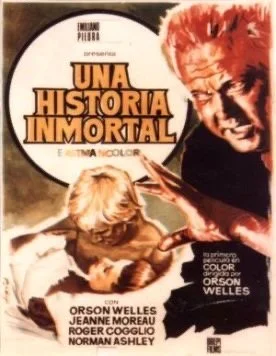
Director: Orson Welles
Cast: Jeanne Moreau, Orson Welles, Roger Coggio, Norman Eshley
Have I Seen it Before: Never. Honestly, this one has always felt like a minor work (perhaps owing to its runtime?) and flew resolutely below my radar.
Did I Like It: I immediately made some assumptions that this would be firmly in that pantheon of latter-day Welles films (along the lines of both F for Fake (1973) and The Other Side of the Wind (2018)) where it must have been made with such a guerrilla mentality that they almost appear cobbled together via 16mm and 8mm film stock, even home video. As his film career well and truly wore out, Welles was cobbling together films from anything he could reach for.
Thus my reactions to the first few minutes (and largely the rest of the film) were filled with pleasant surprises. The opening shot in Macao (Spain, with some Chinese signs strewn about; Welles lived there and had long since struggled to get a production in the US) was made with such a clean, pristine quality, I was immediately certain that this was a film Orson had left unfinished after his death in 1985, and some well-meaning lunkhead got it into their mind to try and release the finished material in something resembling a completed form (for more on this phenomenon, see my review of the released version of Welles’ Don Quixote (1992)).
But it wasn’t. For most of the runtime (slight thought it might be) I thought the film could have been shot at any time. Certainly, the old-age makeup used on Welles during the production are dim, especially when compared to the efforts which still hold up from Citizen Kane (1941). That could be tied directly to the use of color cinematography, for which Welles never really cared. Why Welles really needed any old-age makeup at that point in his life is also a bit beyond me, though.
For one, brief moment (emphasis on the brief). Welles was able to marshal the meager resources he had at his disposal and make an honest-to-God film. One wonders what the man might have been able conjure had he lived a little longer.