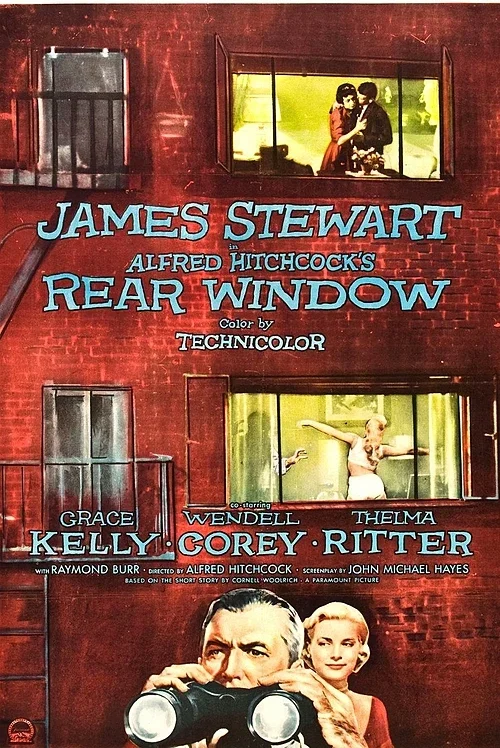
Director: Alfred Hitchcock
Cast: James Stewart, Grace Kelly, Wendell Corey, Raymond Burr
Have I Seen It Before: Oh, sure.
Did I Like It: I always feel like I’m having to dodge and weave a little when it comes to Hitchcock films. I love Psycho (1960). I’ve introduced screenings of it and it would be among the top ten films I would choose to watch to put on after a long day.
But, try as I might, I have never enjoyed Vertigo (1958) half as much as I feel like I’m expected to. And, cashier me out of my Letterboxd subscription if you must, I would put Rear Window closer to the Vertigo end of the spectrum.
But I realized something as I took in Rear Window on the big screen. The reason I’ve spent most of my life thinking Psycho was the peak of Hitchcock’s oeuvre is because it was created with the same production resources that were being used for Alfred Hitchcock Presents. It was tailor-made for repeated views on your glass screen. Most of his other movies were made for Vistavision. TV’s need not apply.
So I’m sitting in a theater and, my phone firmly in my pocket and the visages of Stewart and Kelly fill my view, it becomes clear: Maybe one of these days I finally need to get around to seeing Vertigo on the big screen. Or, failing that, I need to leave my phone in the other room when I’m doing so.
Beyond taking it all in the way it was meant to be seen, there’s a genius-bordering-on-demented quality in Rear Window. It’s really five or six movies that dovetail, collapse, and build on one another, and Jefferies (Stewart) is watching all of them. Some come complete with their own dialogue, others are silent in the purest sense of the word, where they didn’t have to even lean on title cards to get the point across. Rear Window is all movie, and it is all movies.
And you get to spend a good portion of it absolutely dumbfounded that Jimmy Stewart can’t get over himself to marry Grace Kelly.