Party Now, Apocalypse Later Industries

Where creativity went when it said it was going out for cigarettes.
  • Home
  • BOOKS
    • THE ONCE AND FUTURE ORSON WELLES
    • IF ANY OF THESE STORIES GOES OVER 1000 WORDS...
    • ORSON WELLES OF MARS
    • THE DEVIL LIVES IN BEVERLY HILLS
    • A LOSS FOR NORMALCY
    • RIGHT - A NOVEL OF POLITICS
  • PODCASTS
    • Beyond the Cabin in the Woods
    • THE HOLODECK IS BROKEN
    • THE FOURTH WALL
    • As The Myth Turns
    • FRIENDIBALS! - TWO FRIENDS TALKING ABOUT HANNIBAL LECTER
    • DISORGANIZED! A Criminal Minds Podcast
  • MOVIE REVIEWS
  • BLOGS AND MORE
    • Bloggy B Bloggington III, DDS
    • THE HOLODECK IS BROKEN BLOG
    • REALLY GOOD MAN!
  • Home
    • THE ONCE AND FUTURE ORSON WELLES
    • IF ANY OF THESE STORIES GOES OVER 1000 WORDS...
    • ORSON WELLES OF MARS
    • THE DEVIL LIVES IN BEVERLY HILLS
    • A LOSS FOR NORMALCY
    • RIGHT - A NOVEL OF POLITICS
    • Beyond the Cabin in the Woods
    • THE HOLODECK IS BROKEN
    • THE FOURTH WALL
    • As The Myth Turns
    • FRIENDIBALS! - TWO FRIENDS TALKING ABOUT HANNIBAL LECTER
    • DISORGANIZED! A Criminal Minds Podcast
  • MOVIE REVIEWS
    • Bloggy B Bloggington III, DDS
    • THE HOLODECK IS BROKEN BLOG
    • REALLY GOOD MAN!

A Blog About Watching Movies (AKA a Blog in Search of a Better Title)

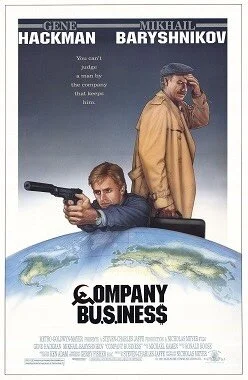
Company Business (1991)

Mac Boyle September 18, 2021

Director: Nicholas Meyer

Cast: Gene Hackman, Mikhail Baryshnikov, Kurtwood Smith, Terry O’Quinn

Have I Seen it Before: Never. It’s been like one of those desert mirages in the world of cinema. It appears on a streaming service every once in a while, and then disappears just as quickly. Only I after I practically tripped over it being included in a double feature DVD with No Way Out (1987) was I able to find it on some kind of physical media.

Did I Like It: I’m tempted to say no, as the great master Meyer himself is certainly down on the film. Hackman agreed to the film, and then turned up on location not wanting anything to do with the proceedings, but facing a lawsuit if he backed out at such a late phase of the proceedings.

But Hackman doesn’t feel like the problem. He seems present enough throughout the film, not one of his all-time-best film performances, but I wasn’t struck by him being completely out to lunch. Baryshnikov isn’t at his core a movie actor, and his character breezes through the film with a perpetually confused expression. 

But the story—and it pains me rather greatly to admit it—may be the problem. It never really comes together. Maybe this is a byproduct of an editing process that had to work through a belligerent leading man’s performance to find some sequence of usable takes. Ultimately, though, I think Meyer still hadn’t worked out what he wanted to say about the end of the Cold War. For that, we’d have to wait—less than a year, incidentally—for Star Trek VI: The Undiscovered Country (1991) to see his thoughts become more concrete. 

I’m sure a studio executive in 1990 would have blanched at the notion that that the spy movie starring Popeye Doyle would be the less successful movie about the fall of the Berlin Wall than a fifth sequel starring a cast of TV actors nearly ready to start collecting Social Security, but here we are.

Tags company business (1991), nicholas meyer, gene hackman, mikhail baryshnikov, kurtwood smith, terry o’quinn
Comment
220px-TimeAfterTime79.jpg

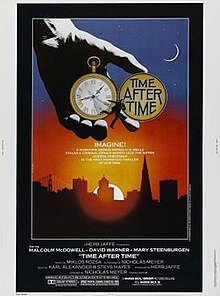
Time After Time (1979)

Mac Boyle May 24, 2020

Director: Nicholas Meyer

Cast: Malcolm McDowell, David Warner, Mary Steenburgen, Charles Cioffi

Have I Seen It Before?: Many, many times.

Did I like it?: It’s a solid bet that I’m going to be effusive about anything even tangentially related to Nicholas Meyer, the director of a solid candidate for my favorite film of all time, Star Trek II: The Wrath of Khan (1982). I have a certain soft spot for Volunteers (1985), and I even find some charm in Company Business (1991), even though Meyer largely disowns the film, and I have a hard time getting through it in one sitting.

But this movie is one for the books. As a zealot of the time travel genre, this is in my personal pantheon. I love it without question. I love it so much that I had no choice but to watch the abortive attempt to make a television series out of the concept several years ago. If I ever make something half as good as this movie, my time in creative endeavors will be well-spent.

And it’s odd, even for the year in which it was released, it has a certain antiquated feel. It has far more in common with a film like The Time Machine (1960) than later films like Back to the Future (1985). It even influenced later films, influencing the casting of Back to the Future Part III (1990) and meriting a reference along with other entries of the genre in Avengers: Endgame (2019).

The films strengths rest in the writing and performances. Meyer is physically unable to produce a script that isn’t thoroughly literate. The film ebbs and flows on the philosophies of H.G. Wells, which is only made more ironic when one considers that with his utopian ideals and gentlemanly manor, he is the idealized Star Trek hero in the Gene Roddenberry mold at the center of a film made by a man who tried to revitalize that same genre with newer and fresher interpretations. It doesn’t hurt that left-over ideas from this film helped fuel the eventual screenplay for Star Trek IV: The Voyage Home (1986).

Malcolm McDowell eschews the hostile icon he made of himself in A Clockwork Orange (1971) in favor of a hero who is comedically overpowered by the proceedings, but will not be obliterated by an uncaring world. David Warner is so quietly effective as the mad Jack that to this day I’m delighted when I see him appear in anything.

If you haven’t watched the film before today, please go make arrangements to view it immediately. We can then keep being friends once that deficiency is rectified.

Tags time after time (1979), time travel movies, nicholas meyer, malcolm mcdowell, david warner, mary steenburgen, charles cioffi
Comment
220px-Star_Trek_II_The_Wrath_of_Khan.png

Star Trek II: The Wrath of Khan (1982)

Mac Boyle February 17, 2020

Director: Nicholas Meyer


Cast: William Shatner, Leonard Nimoy, DeForest Kelley, Ricardo Montalbán


Have I Seen it Before: Hoo, boy. Long established in my family lore is the screening my mother went to at a second-run theater in the summer of 1984. As the USS Reliant exploded in a wave of the Genesis Effect, I—a learned elder, as far as fetuses were concerned—decided to give my ma a bit of a break and cut it out with the kicking and whatnot. It’s entirely possible that while some babies were exposed to classical music or the neurosis and bitterness of their parents in utero, I absorbed the bombastic score of James Horner and the sneering villainy of Khan Noonien Singh (Montalbán) as the foundation of my very being.


The first time I remember watching the movie while sentient was on a feeble VHS copy. I couldn’t have been more than ten years old and spent the rest of the day giddily recounting the plot to anyone who would listen. This time, my poor suffering mother got the raw end of the deal and had to hear a ten-year-old’s impression of a Ceti eel.


During this particular screening, I was able to lip sync every line of dialogue. I even felt the need to argue with several of the trivia questions before the feature presentation. Because they were wrong.


Yes. I’ve seen it a couple of times.


Did I Like It: At one point after the nadir of Star Trek: Nemesis (2002) and the particularly wheel-spinning seasons of Star Trek: Enterprise, I wondered quietly whether I actually didn’t care much for Star Trek at all, but was so in love with this film that I was willing to give every other entry in the series a pass because it shared some basic elements with this film.


It is a thrilling story, told at a breakneck pace that still manages to let smaller character moments have their due time. It is about friendship, and aging, and revenge, and sacrifice, and living the first, best destiny you know in your bones. It is told with a startling simplicity that allows fully-steeped fans and newcomers alike to delight in the proceedings. Any time I am trying to create a story on my own, I’m reaching for an experience somewhere in the vicinity of this film.


It is not only my favorite Star Trek film, it is certainly one of my favorite movies of all time. It may be my favorite film of all time, although I tend to blanche at ranking these things so precisely.


Every time I see the film, I notice something new. During this particular screening I noticed that Chekov (Walter Koenig) is not seen on screen after purging himself of the Ceti eel without cotton in his bloodied ear. Also, somehow I had never put together that the Genesis Effect billowing out of the Reliant also caused the Mutara Nebula to collapse in on itself, harnessing the material of the nebula to create the Genesis Planet that would be the setting of most of the action of Star Trek III: The Search For Spock (1984). I honestly don’t know how it has taken longer than my actual lifespan to put that one together. It is a film that keeps on giving.


And yet, it is not a perfect film. The subplot with Midshipman Preston (Ike Eisenmann) doesn’t resonate, and it is only in the director’s cut (first released in 2002) that things are slightly illuminated, although I still don’t understand why Scotty (James Doohan) brought the poor suffering crewman to the bridge first, and not directly to sickbay. Additionally, the effects of the Genesis Cave on the Regula planetoid are alternately a triumph of matte work (back when such a thing was still done) and a completely befuddling choice in animated optical processing. But the flaws give me comfort. Even if I am flawed in my own work, I can still reach for the ideal. 


As with most films, watching it at home on a television is only imitating the experience in many ways. I had the delight to see it a few years ago during a Fathom Event screening. Seeing it projected on the big screen was a blissfully different experience. However, that screening was sparsely populated. This time, I saw it in conjunction with a live event hosted by none other than William Shatner. While the Captain Kirk emeritus was understandably more interested in talking about Star Trek V: The Final Frontier (1989), seeing the film with a packed and enthusiastic crowd was sublime. The cheering for cast members during the opening credits, the polite applause for GOAT writer-director Nicholas Meyer (which I believe he would have found staggeringly appropriate), the laughing at jokes I had long since internalized, and the genuine feeling that accompanied the climax gave every inch of the film a new life, as if it had been goosed by the Genesis Wave itself. I couldn’t help but feel like Kirk at the end. A movie that was old news at my birth was all new again.


I couldn’t help but feel young.
Tags star trek ii: the wrath of khan (1982), star trek movies, nicholas meyer, william shatner, leonard nimoy, deforest kelley, ricardo montalbán
Comment
220px-Star_Trek_VI-poster.png

Star Trek VI: The Undiscovered Country (1991)

Mac Boyle January 1, 2019

Director: Nicholas Meyer

Cast: William Shatner, Leonard Nimoy, DeForrest Kelley, Kevin Spacey Christopher Plummer*

Have I Seen it Before: Well, this is the first film in the Star Trek series I’ve reviewed, so unless we happen to be dealing with a new release, it’s a pretty safe bet that I’ve seen it before.

Did I Like It: It might objectively be the best Star Trek film of all time. Does that mean it is the best Star Trek film of all time, or even the best Star Trek film directed by Nicholas Meyer? Well, that’s a different story.

I’ve written a couple of times in these reviews about timelessness in films. It’s appropriate to broach the subject of the film, because the notion was put into my head by Meyer, and he perfects the reach for a timeless quality in this film. Beyond a few scant special effects that might have been a little ahead of their time, there’s not really an aspect of this movie, from the music, to the cinematography, all the way to the hair styles, there is almost nothing about this film that restricts it to being made in the early 1990s. It’s a marvel to behold, and a phenomenon that Meyer’s other great space-opera Star Trek II: The Wrath of Khan (1982) can’t even claim, even though that is one of my all-time top five movies.

Even the one element that threatens to make the film strictly of its time manages to transcend. Clearly a parable about the end of the Soviet Union (with just a pinch of Watergate-esque intrigue thrown in for good measure), the film is clearly commenting about the end of the 80s and the beginning the 90s. The Klingons have their own version of Chernobyl, unrelenting hostilities are coming to an unfathomable end, and the old guard is to varying degrees uncomfortable with the forthcoming future, or the titular undiscovered country**. But I think it may be a byproduct of living in a political era that could—politely—called “interesting” that the macro machinations of the galaxy here can’t help but feel relevant to the here and now. This is when Star Trek often works the best, and it shows.


* Could you imagine? Don’t. #2017jokesfiresale

** Which is a strange title for this film, if treated to any further scrutiny. The Wrath of Khan was originally called The Undiscovered Country, and as it is an allusion to Hamlet, and specifically death, it feels more appropriate to that film. Here, it is essentially saying that the sometime arduous road to peace only ends in death. Ominous. Mad ominous, folks. 

Tags star trek vi: the undiscovered country, star trek film series, nicholas meyer, william shatner, leonard nimoy, deforrest kelley, christopher plummer
Comment

Powered by Squarespace

Party Now, Apocalypse Later Industries

Where creativity went when it said it was going out for cigarettes.

Where creativity went when it said it was going out for cigarettes.