
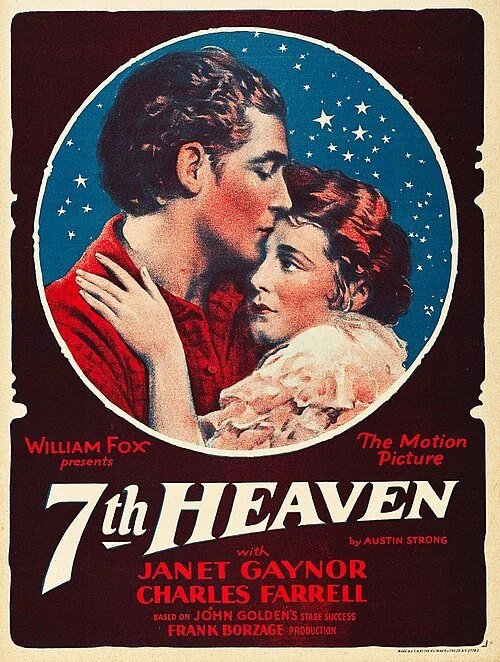
Director: Frank Borzage
Cast: Janet Gaynor, Charles Farrell, Ben Bard, Albert Gran
Have I Seen it Before: Never.
Did I Like It: I reflexively want to point to some of the last films of the silent era as the more cinematic entries in the form, as if before filmmakers started synchronizing sound, Hollywood was committed to perfecting the form.
That notion holds up for the most part here, but maybe not entirely. I keep wanting to point to Chaplin’s slow, uneasy transition to sound. He had something to prove by keeping words out of the Tramp’s mouth for as long as he did, hence City Lights (1931), Modern Times (1936), and to some degree The Great Dictator (1940) were among his best films.
This film ends up being better than most of the sound films produced in the era, never once feeling like a stage play recorded for wider distribution, but it is not to the level of those other films, not even close. The production value is superb, believably traveling from the slums of Paris, all the way through a semi-believable depiction of World War I.
With that scale comes some problems that only get worse for movies as time goes on. That range of scope also gives the film an inability to focus. Is this film about a man (Farrell) rising up from the sewers to become a street cleaner? Is it about that same man’s eventual service in the war? Is it about his wife’s (Gaynor) belief that he is still alive and will come back to her? Is it about her earlier days as a prostitute pimped out by her sister (Gladys Brockwell)? Beats the hell out of me, and the film doesn’t seem particularly sure on the answers, either. It also ends half a dozen times before the end credits finally roll.
I will give the film credit for one thing. Characters return to Chico’s loft several times over the course of the film, and every time it happens I’m left wondering exactly how they did the shot. We follow characters as they move tentatively up several flights of stairs to the room in question, following them from floor to floor. Was it an optical wipe going from several different shots, a significant evolution in montage theory only a few years after Battleship Potemkin (1925)? Or did the filmmakers embrace the expense of building an elaborate set that went all the way up? I honestly couldn’t tell, and if a film nearly 100-years-old can leave me wondering how something was done, it can’t be all bad.