Party Now, Apocalypse Later Industries

Where creativity went when it said it was going out for cigarettes.
  • Home
  • BOOKS
    • THE ONCE AND FUTURE ORSON WELLES
    • IF ANY OF THESE STORIES GOES OVER 1000 WORDS...
    • ORSON WELLES OF MARS
    • THE DEVIL LIVES IN BEVERLY HILLS
    • A LOSS FOR NORMALCY
    • RIGHT - A NOVEL OF POLITICS
  • PODCASTS
    • Beyond the Cabin in the Woods
    • THE HOLODECK IS BROKEN
    • THE FOURTH WALL
    • As The Myth Turns
    • FRIENDIBALS! - TWO FRIENDS TALKING ABOUT HANNIBAL LECTER
    • DISORGANIZED! A Criminal Minds Podcast
  • MOVIE REVIEWS
  • BLOGS AND MORE
    • Bloggy B Bloggington III, DDS
    • THE HOLODECK IS BROKEN BLOG
    • REALLY GOOD MAN!
  • Home
    • THE ONCE AND FUTURE ORSON WELLES
    • IF ANY OF THESE STORIES GOES OVER 1000 WORDS...
    • ORSON WELLES OF MARS
    • THE DEVIL LIVES IN BEVERLY HILLS
    • A LOSS FOR NORMALCY
    • RIGHT - A NOVEL OF POLITICS
    • Beyond the Cabin in the Woods
    • THE HOLODECK IS BROKEN
    • THE FOURTH WALL
    • As The Myth Turns
    • FRIENDIBALS! - TWO FRIENDS TALKING ABOUT HANNIBAL LECTER
    • DISORGANIZED! A Criminal Minds Podcast
  • MOVIE REVIEWS
    • Bloggy B Bloggington III, DDS
    • THE HOLODECK IS BROKEN BLOG
    • REALLY GOOD MAN!

A Blog About Watching Movies (AKA a Blog in Search of a Better Title)

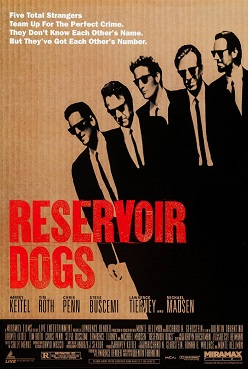
Reservoir Dogs (1992)

Mac Boyle October 21, 2024

Director: Quentin Tarantino

Cast: Harvey Keitel, Tim Roth, Chris Penn, Steve Buscemi

Have I Seen it Before: Oh, sure. You don’t live in the dorms for any stretch of the mid-2000s without taking in all of the Tarantino library.

Did I Like It: This is probably the Tarantino film I’m least inclined to re-visit, but I think I’ve spent more than a few years being unfair in that regard. My memory of the film is that it was always a bit simplistic. That isn’t necessarily a mark against the film. Given the resources Tarantino was working with, the film didn’t really have any hope of being more of a prototype for what Tarantino would eventually have in store for us.

The film is infinitely more complex than my memory gave it credit. Tarantino introduces himself to the movie-going world with the same kind of unhinged, borderline-bonkers plot construction he would later perfect* in Pulp Fiction (1994).

You may be like me and mostly remember the opening diner scene where the characters disassemble Madonna’s “Like a Virgin” or the torture scene complete with a needle drop of “Stuck in the Middle with You.” But the entire story keeps its secrets from us for as long as it wants to, and not a second longer, and only reveals them not when the flow of the ill-fated heist demands it, but when it will mean the most to us in our journey with the characters.

You might be like some of the critics of the age who are irretrievably turned off by the use of language and the violence. The immediate answer to those complaints is that you’re likely to have a devil of a time with the rest of Tarantino’s films, but I would add on to say that every line of dialogue is built to reveal character, even when those characters are helplessly awful. As far as the violence is concerned, I suppose I understand the complaints about violence in Tarantino’s films, but whereas light PG-13 depict violence as bloodless, barely notable events, it is difficult to say that Tarantino treats his violence blithely. Every drop of blood is bled from wounds that hurt, and that means more than finding a character amidst a maelstrom of bullets and blades only to come out with a scratch.

*And subsequently abandon, It’s a little disappointing that Tarantino never really continued his experiments with non-linear narratives, but then one supposes that if you start experimenting, and then perfect it in the next outing, are there really any experiments left to do?
Tags reservoir dogs (1992), quentin tarantino, harvey keitel, tim roth, chris penn, steve buscemi
Comment

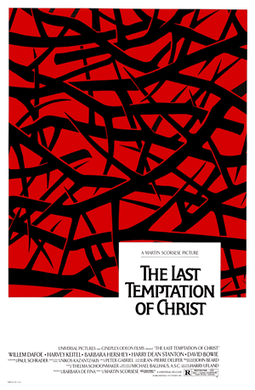
The Last Temptation of Christ (1988)

Mac Boyle August 20, 2022

Director: Martin Scorsese

Cast: Willem Dafoe, Harvey Keitel, Barbara Hershey, Harry Dean Stanton

Have I Seen it Before: Never. Chalk it up to another another cinematic blind spot. As a blissful non-Christian I’m neither offended by the film’s creative liberties and abandonment of the gospels, nor am I particularly moved by the subject matter in the first place. From a distance, I feel almost the same way about the film as I would The Passion of the Christ (2004). I really have to be “in the mood” for a picture about a crucifiction, and I rarely—if ever—am. The key difference is that Scorsese on spec is much more apt to get me “in that mood” than Gibson, or even Jeffrey Hunter, for that matter.

Did I Like It: The film is clearly well made. It would be foolish in the extreme to question the bona fides of Scorsese. The beginning and the ending are undeniably fascinating. Depicting the moral grey area of Jesus (Dafoe) is a revelation that might actually invite a viewer to move beyond the ethical vacuum that Christianity can sometimes create in its followers. Faith alone is nearly worthless if you are more than willing to bring your carpentry skills to bear on a full array of crucifixes. The ending, where Jesus is given something resembling a choice in his fate makes his sacrifice have even some kind of meaning, even for this particular non believer.

The middle, however, could be counted among any other depictions of the life of Jesus one might find. The film is almost too devout at the core, that it once again becomes meaningless. It’s ultimate reverence (and, for that matter, Peter Gabriel score weighing everything down in an 80s milieu) for its subject material keeps me further from the subject matter.

Maybe it should have been more irreverent? That might have cut through my cynicism and gotten me on board. The zealots don’t know a good thing when they have it heading straight for them.

Tags the last temptation of christ (1988), martin scorsese, willem dafoe, harvey keitel, barbara hershey, harry dean stanton
Comment

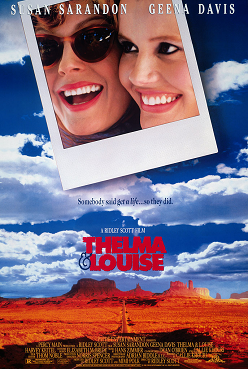
Thelma & Louise (1991)

Mac Boyle May 3, 2022

Director: Ridley Scott

Cast: Susan Sarandon, Geena Davis, Harvey Keitel, Michael Madsen

Have I Ever Seen It Before: Never, which seems like preposterous blind spot, I know.

Did I like it: Is there any director other than Ridley Scott who has such a tonnage of absolute classics under his belt (and a few stinkers; let’s not completely lose our heads), and have those classics reside in such complete different genres? Spielberg may be as prolific, but he generally has his Amblin period, and his Oscar-bait period, and nearly every one of his films can fit into those large categories. Kubrick is certainly varied, but between a more high brow sensibility and a compulsive need to do scores of takes, there are only a handful of films in the canon. It’s Ridley Scott and only Ridley Scott for this particular category.

And so it is with this film, that an unlikely source creates an unabashedly feminist film. If the film came to the surface now, it would be beset by complaints over over-wokeness, and the only comfort I get from that realization is that it was also beset by those bad faith arguments, so maybe all lousy criticism (including, sometimes, the ones that appear on this site) will eventually evaporate into the ether, and the really good stuff will remain. Every man in this movie lands on some end of the terrible spectrum, and if that bothers you, well, 1991 called and wants its bullshit back.

And that’s what this is, the writing is top notch, often funny, and never boring. Sarandon and Davis are never better, bringing the simmering strength and still ingrained weakness in equal measure. There’s an absolute reason it is a classic.

Which brings us to the ending. No conversation about this movie would be complete without touching upon the final moments, as those are the ones that have become the most iconic over the years. It may be my least favorite thing about the film. The action of driving the car off the cliff feels tacked on somehow. The action of going out in a blaze of glory is fine, and absolutely flows from the film that precedes it. Perhaps the production ran out of money to have they turn around and make the various cops pay for their chase. Maybe I’m just bothered by how the polaroid of them from the beginning managed to stay just so on the backseat through that whole action sequence, only to fly off at the moment of maximum pathos. Maybe I don’t like the fact that my idiot brain thinks for a moment they might have made it.

It’s a minor complaint.

Tags thelma & louise (1991), ridley scott, susan sarandon, geena davis, harvey keitel, michael madsen
Comment

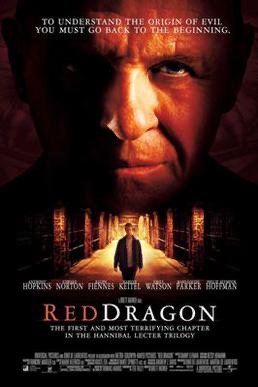
Red Dragon (2002)

Mac Boyle April 8, 2022

Director: Brett Ratner

Cast: Anthony Hopkins, Edward Norton, Ralph Fiennes, Harvey Kietel

Have I Seen it Before: Oh, sure. For some reason I can’t remember if I saw this or Manhunter (1986) first, but I think it might have been this one, as I saw it in the theater during my halcyon days as a high school senior, and I’m almost certain I didn’t see Manhunter until college. But who can remember anymore? My memory palace is for shit, if you’ll forgive my rudeness.

Did I Like It: No discussion of this film—as the eventual episode of Friendibals will attest—can be complete without dwelling on one topic before any others. No, it isn’t the inevitable comparisons of William Petersen vs. Edward Norton (they’re both fine; Petersen is more demonstrably mad around the edges), Ralph Fiennes vs. Tom Noonan (Fiennes feels more developed, but that might owe more to the script than anything else), Mann vs. Ratner (Mann is always stylish to the fault, so much so to the point that his films feel dated minutes after they’re released, while I don’t think Ratner has had an artistic ambition greater than calling “action” and “cut” when he’s supposed to), and ultimately Cox vs. Hopkins (the pictures for Hopkins’ obituary will inevitably include Lecter, although he feels bored and overly hammy here, whereas Cox relaxes into his evil).

While an analysis of all of these topics will give a pretty good picture of where this film lies not only against its previous adaptation, but among the rest of the Lecter series and serial killer films as a whole, the one topic that must, without a doubt be discussed is Mrs. Doubtfire (1993).  Yes, that one. The one with Pierce Brosnan*.

While going through the Leeds home, Graham (Norton) looks through a drawer of VHS tapes, before watching their home movies and staring at, but never really seeing the way he will catch the Tooth Fairy (Fiennes). Among the tapes area copy of Jaws (1975), which makes sense as it is also a Universal Release, the artwork features nothing that might run afoul of likeness rights, and most importantly, clearly something that would be available on home video “several years” after Graham runs afoul of Lecter in the film’s prologue.

But why the hell is Mrs. Doubtfire there? Are we saying this film takes place in (at the earliest) 1994? What does this say about when The Silence of the Lambs (1991) or, for that mater Hannibal (2001) take place?

I may have missed the point of the whole thing, but if I can zero in on that for most of the film’s runtime—in a series that’s main stock and trade is characters noticing things and making connection which not everyone else might—then maybe it’s the film’s—and really, Ratner’s—fault for not getting Doubtfire out of the Leeds’ house. I submit to you that, for all his journeymen level work and the cast’s impressive ability to elevate the proceedings, Brett Ratner missed the point, not I.


*Am I remembering that right? Was Pierce Brosnan in Mrs. Doubtfire. I’m almost sure he was, and I kind of don’t want to go look it up to find out.

Tags red dragon (2002), brett ratner, hannibal lecter movies, anthony hopkins, edward norton, ralph fiennes, harvey keitel
Comment

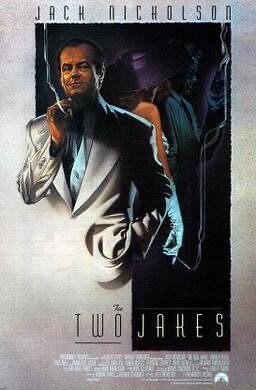
The Two Jakes (1990)

Mac Boyle June 12, 2021

Director: Jack Nicholson

Cast: Jack Nicholson, Harvey Keitel, Meg Tilly, Madeline Stowe

Have I Seen it Before: Never. It’s always been sort of a random fascination for me, given that it was the essentially forgotten sequel to Chinatown (1974), but it’s always managed to remain elusive, what with it being uncelebrated and never appearing on a streaming service. To my knowledge, I had never even laid hands on a DVD copy of it until recently, and with that morbid curiosity taking thrall, I had to have it.

Did I Like It: I don’t think I’d get a lot of pushback when I put Jack Nicholson as one of the greatest movie stars of all time. Many may not believe that my judgment there isn’t exclusively tied to Batman (1989), but I assure you it is not.

He’s not much of a director. It’s not his fault. Throughout his career, he did his level-headed best to not take the task on all that much. This ilm only came about because by all indications this film should have languished in development hell before ceasing to exist, like the third in the Gittes trilogy did after this film was received with a collective shrug.

Nicholson’s performance is fine here, but I can’t help but feel he’s distracted. Although, to be fair, I wonder whether I would think that if I didn’t know he also directed. The screenplay from Robert Towne is constructed with the same level of craft he brought to all of his scripts, and which made Chinatown one of the most celebrated—and studied—examples of the form. The direction, however, is merely competent. There is nothing wrong, but there is no artistry, mainly because Jack was the last man left to direct it, not because he had a burning desire to do so.

Curiosity sated. Would I recommend you watch the movie yourself? Only if you must, which I did.

Tags the two jakes (1990), jack nicholson, harvey keitel, meg tilly, madeline stowe
Comment
220px-Movie_national_treasure.JPG

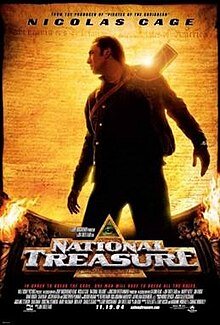
National Treasure (2004)

Mac Boyle February 23, 2020

Director: Jon Turteltaub


Cast: Nicolas Cage, Harvey Keitel, Jon Voight, Diane Kruger


Have I Seen it Before: Yes…


I think.


Did I Like It: This movie has a certain place in the mythology of my house. My wife (then girlfriend) and I were on a road-trip to Washington DC to attend the Rally To Restore Sanity/Fear in 2010. It was a miserable trip, packed for days into a bus filled with other Oklahomans who apparently could only subsist on a diet of all-you-can-eat buffets. What’s more, we missed the Rally. My intention was to propose to Lora as close as possible to the command module Columbia, but an absolutely packed National Mall made that impossible.


So, I proposed in front of the Declaration of Independence at the National Archives.


That’s it. That’s the whole anecdote, and the primary reason why everyone in my family gets a wry smile on their face whenever the subject of the film comes out.


And so, I’m watching it like it’s been a family tradition to watch it repeatedly. And I’m not remembering much of it. Like, I kept expecting Christopher Plummer to show up again. I even remembered him showing up again in the movie, but he doesn’t show up.


Why is that? Could it be that it’s a pretty forgettable movie? A smoothed-out Disneyfied heist movie that would feel inaccurate to anyone who had so much as heard of American History? A weird commercial for the Freemasons? Could it feature a weirdly sedated Nicolas Cage, the one film actor in all of cinema who you bring on to add an undercurrent of crazy to the proceedings? Is it possible the score is a weird mish-mash of high-action epic and forensic procedural?


No, it’s probably none of those things. Ultimately, it’s probably the fact that the rotunda at the National Archives are nowhere near that brightly lit, because I’ve been there.

Tags national treasure (2004), jon turteltaub, nicolas cage, harvey keitel, jon voight, diane kruger
Comment

Powered by Squarespace

Party Now, Apocalypse Later Industries

Where creativity went when it said it was going out for cigarettes.

Where creativity went when it said it was going out for cigarettes.