Party Now, Apocalypse Later Industries

Where creativity went when it said it was going out for cigarettes.
  • Home
  • BOOKS
    • THE ONCE AND FUTURE ORSON WELLES
    • IF ANY OF THESE STORIES GOES OVER 1000 WORDS...
    • ORSON WELLES OF MARS
    • THE DEVIL LIVES IN BEVERLY HILLS
    • A LOSS FOR NORMALCY
    • RIGHT - A NOVEL OF POLITICS
  • PODCASTS
    • THE HOLODECK IS BROKEN
    • THE FOURTH WALL
    • Beyond the Cabin in the Woods
    • FRIENDIBALS! - TWO FRIENDS TALKING ABOUT HANNIBAL LECTER
    • As The Myth Turns
    • DISORGANIZED! A Criminal Minds Podcast
  • MOVIE REVIEWS
  • BLOGS AND MORE
    • Bloggy B Bloggington III, DDS
    • THE HOLODECK IS BROKEN BLOG
    • REALLY GOOD MAN!
  • Home
    • THE ONCE AND FUTURE ORSON WELLES
    • IF ANY OF THESE STORIES GOES OVER 1000 WORDS...
    • ORSON WELLES OF MARS
    • THE DEVIL LIVES IN BEVERLY HILLS
    • A LOSS FOR NORMALCY
    • RIGHT - A NOVEL OF POLITICS
    • THE HOLODECK IS BROKEN
    • THE FOURTH WALL
    • Beyond the Cabin in the Woods
    • FRIENDIBALS! - TWO FRIENDS TALKING ABOUT HANNIBAL LECTER
    • As The Myth Turns
    • DISORGANIZED! A Criminal Minds Podcast
  • MOVIE REVIEWS
    • Bloggy B Bloggington III, DDS
    • THE HOLODECK IS BROKEN BLOG
    • REALLY GOOD MAN!

A Blog About Watching Movies (AKA a Blog in Search of a Better Title)

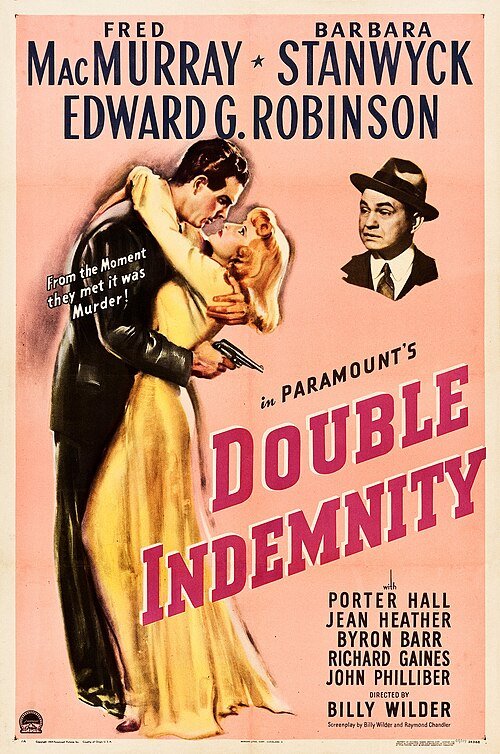
Double Indemnity (1944)

Mac Boyle July 30, 2026

Director: Billy Wilder

Cast: Fred MacMurray, Barbara Stanwyck, Edward G. Robinson, Porter Hall

Have I Seen It Before: Never. I’ve been spending the better part of the last three years watching every noir under the sun (although that should probably be under the bleak, rainy sky) and this one has been on the radar the entire time.

Did I Like It: And rightly so. It is, if nothing else, the quintessential Film Noir. After a year of watching other films in the genre, its tempting to feel something like discontentment, and that I’ve seen all of this before, but the considered opinion is that this was the spring from which this format mostly sprung, and ever b-crime picture made for the next ten years was desperately trying to capture something of Double Indemnity’s magic.

And it is, indeed, all there. A working-class schmo (MacMurray) gets mixed up with an unattainable, but still somehow available—usually married—woman (Stanwyck). All of their money troubles will evaporate all of a sudden if they just kill some ultimately harmless jerk (Tom Powers). Things go mostly great, except for one little problem. Loyalties bounce around, and are schmo gets his comeuppance, reminding everyone as he goes to his fate—be it prison or the great beyond—that he wasn’t a bad guy. He just got mixed up with the wrong dame.

Mix. Repeat.

This may sound like damning the film with faint praise, but it’s a pretty good format to originate. It naturally builds tension as the world starts collapsing in on the schmo. One wonder if it might have even kept a few potential schmoes from starting the cycle in their own lives.

The only real complaint I have against the film comes, again, from the disadvantage of age and experience. Just as I came to this film late, I can’t help but look at MacMurray, remember years of Nick at Nite and the Disney channel, and seeing not a dangerous criminal in too far, but the dad from My Three Sons and various riffs on The Absent-Minded Professor (1961).

Gee, I wish I could somehow be unmoored from the constraints of time and see every movie in the context for which they were meant.

Tags double indemnity (1944), billy wilder, fred macmurray, barbara stanwyck, edward g robinson, porter hall
Comment
220px-The_Stranger_(film).jpg

The Stranger (1946)

Mac Boyle August 11, 2019

Director: Orson Welles

Cast: Edward G. Robinson, Loretta Young, Orson Welles, Philip Merivale

Have I Seen it Before: The answer to that question may be longer than the review itself.

I bought a copy of this film on DVD many years ago. Life happened, I bought other DVDs, and somehow I never got around to watching it. At some point, it became a weird totem in my life. On the verge of some great life change, I would finally break down and watch it. Cut to four years later, an old life is falling apart around me and I’m on the eve of starting a job that may well end up filling the rest of my life.

Now, this next part—an ironies of all ironies—is going to sound like diversion, but it’s all part of the story: this is the only film Welles directed that was bonafide box office hit upon its release. Despite that financial success, it’s also the only Welles film that not only slipped into the public domain, but so lapsed while Welles was still alive.

Since The Stranger is in public domain, the DVD copy turned out to be absolute garbage. It’s a copy of a copy of a copy of a VHS version that was pulled from a 16mm print that had probably seen better days in the 90s when it was originally created. Flummoxed beyond all reason that I had waited so long to watch what turned out to be a trash release from a fly-by-night DVD label, I threw the disc in the trash*.

Actually, I threw it out a window in a fit. Not wanting to litter, I went out and retrieved it from the yard before eventually throwing it in the trash.

This is all to say that I’ve only seen about ten minutes of the movie in the past.

But enough about my struggles to find a decent copy of the film or Welles’ historical struggles in the movie business, a topic I could—and have and will—go on about at length. Let’s talk about the movie.

Did I Like It: Now, I can say that—despite the shoddy quality of the presentation*—the film is one hell of a firecracker. 

The notion that a prominent Nazi war criminal might now seem like a historical oddity (or at least it did until the last few years, but I digress), but in 1946 when this film was released, it’s easy to imagine people emerging from a theater not 100% sure their neighbors or even their spouses might be refugees of the third reich.

Which, I suppose would account for much of the paranoia that permeated America over the next several decades. 

But seriously, though, that moment where Kindler/Rankin idly draws a swastika on a telephone pad is one of the more deliciously subtle displays of archvillainy in the movies. By the time he’s casually telling his new bride that he intends to kill her, it’s lethal believability is unassailable.

This film, along with Touch of Evil (1958) and The Lady of Shanghai (1947) cement Welles’ credentials as a thriller filmmaker among the ranks of Hitchcock. It’s more of a tragedy that the Hollywood system was so intent on limiting the man, he might have made more films in this vein and had a truly unrivaled catalogue of work as his legacy.


*And it is truly odious. The film ends and a laughable commercial for the fly-by-night DVD imprinter is immediately run, along with credits for that commercial. There’s even a little watermark that occasionally appears throughout the film, which makes me feel like I discovered the movie on late-night cable. All right, I suppose that quality has something resembling charm.

Tags the stranger (1946), orson welles, edward g robinson, loretta young, phillip merivale
Comment

Powered by Squarespace

Party Now, Apocalypse Later Industries

Where creativity went when it said it was going out for cigarettes.

Where creativity went when it said it was going out for cigarettes.