Party Now, Apocalypse Later Industries

Where creativity went when it said it was going out for cigarettes.
  • Home
  • BOOKS
    • THE ONCE AND FUTURE ORSON WELLES
    • IF ANY OF THESE STORIES GOES OVER 1000 WORDS...
    • ORSON WELLES OF MARS
    • THE DEVIL LIVES IN BEVERLY HILLS
    • A LOSS FOR NORMALCY
    • RIGHT - A NOVEL OF POLITICS
  • PODCASTS
    • Beyond the Cabin in the Woods
    • THE HOLODECK IS BROKEN
    • THE FOURTH WALL
    • As The Myth Turns
    • FRIENDIBALS! - TWO FRIENDS TALKING ABOUT HANNIBAL LECTER
    • DISORGANIZED! A Criminal Minds Podcast
  • MOVIE REVIEWS
  • BLOGS AND MORE
    • Bloggy B Bloggington III, DDS
    • THE HOLODECK IS BROKEN BLOG
    • REALLY GOOD MAN!
  • Home
    • THE ONCE AND FUTURE ORSON WELLES
    • IF ANY OF THESE STORIES GOES OVER 1000 WORDS...
    • ORSON WELLES OF MARS
    • THE DEVIL LIVES IN BEVERLY HILLS
    • A LOSS FOR NORMALCY
    • RIGHT - A NOVEL OF POLITICS
    • Beyond the Cabin in the Woods
    • THE HOLODECK IS BROKEN
    • THE FOURTH WALL
    • As The Myth Turns
    • FRIENDIBALS! - TWO FRIENDS TALKING ABOUT HANNIBAL LECTER
    • DISORGANIZED! A Criminal Minds Podcast
  • MOVIE REVIEWS
    • Bloggy B Bloggington III, DDS
    • THE HOLODECK IS BROKEN BLOG
    • REALLY GOOD MAN!

A Blog About Watching Movies (AKA a Blog in Search of a Better Title)

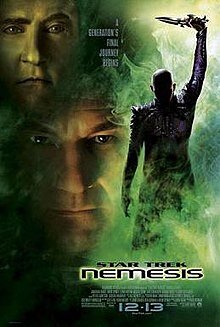
220px-Star_Trek_Nemesis_poster.jpg

Star Trek: Nemesis (2002)

Mac Boyle February 17, 2020

Director: Stuart Baird

Cast: Patrick Stewart, Jonathan Frakes, Brent Spiner, Tom Hardy

Have I Seen It Before?: Oh, yes. Funny story: In early December 2002, I had my wisdom teeth removed. I tried to get clear-headed enough from all of the pain medication so I could make it to a screening of this film during its opening weekend. As the film, sort of happened in front of me it felt all wrong, so much so that as the end credits limped into existence, I shouted in the middle of the theater, “What the hell was that?” Apparently I still had some cotton in my mouth, and more than a little painkillers in my system, and a little cotton in my motuh, so it sounded more like, “Wha tha hee iyat?” But the point remains.

Did I like it?: See the previous statement.

I love Star Trek, and 2000s/1990s when it seemed like there would never be a shortage of Trek material, it felt like there was plenty of room to thoroughly dislike the entries that didn’t hold up.

The film is not a celebration of a beloved TV franchise, but more the final strained compromise of years’ worth of studio politics. Stuart Baird only got the director seat because he did Paramount a solid by doing a last-minute editing jobs on Mission: Impossible II (2000) and Lara Croft: Tomb Raider (2001). One might say that the great film editors shouldn’t direct Star Trek films after the muddled affair that was Star Trek: The Motion Picture (1979), but Robert Wise edited films like Citizen Kane (1941) and had previously directed The Day the Earth Stood Still (1951) and West Side Story (1961). Stuart Baird got the movie Supernova (2000) into some form that could be released in theaters, after directing the distinctly unmemorable Executive Decision (1996) and U.S. Marshals (1998) and hasn’t been allowed to direct a film since.

There’s a temptation to make the review a list of complaints. They artificially lowered the dialogue for Worf (Michael Dorn) to where he is inexplicably the actor with the most screen time in all of Trek, and somehow unrecognizable. The films based on The Next Generation never successfully utilized Beverly Crusher (Gates McFadden) and things are certainly no better here. The film desperately wants to be The Next Generation’s answer to Star Trek II: The Wrath of Khan (1982), and the desperation shows.

And yet, since it ushered in an era of a Trek desert, I don’t want to think of the film as a total loss. It’s the last film to feature a score by Jerry Goldsmith, so one wants to revel in what we have left. The ending originally felt like a sour note to end the time with The Next Generation crew with a whimper, but thankfully Star Trek: Picard is here to continue the adventures of the man from La Barre, and it solidifies the sacrifice of Data as genuine far more than the deaths of other characters in the Trek series over the years.
Tags star trek nemesis (2002), stuart baird, patrick stewart, jonathan frakes, brent spiner, tom hardy
Comment
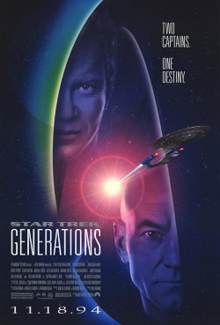
S07-Star_Trek_Generations-poster_art.png

Star Trek: Generations (1994)

Mac Boyle July 9, 2019

Director: David Carson

Cast: Patrick Stewart, Brent Spiner, William Shatner, Whoopi Goldberg

Have I Seen it Before: I saw it before I ever saw it. More on that in a minute.

Did I Like It: It’s exactly what we the fans probably wanted from a first Next Generation film, but it may be that we don’t really know what we want, as the film ultimately winds up a disappointment.

I feel this film far more than I think about it, and I think that’s the fundamental truth about it. 

It is the summer of 1994. Star Trek: The Next Generation has just gone off the air with an epic, perfectly-formed final episode that doesn’t really serve as a finale. All of the characters—in true TV fashion—haven’t changed. The TV audience—including 9-year-old me—are fine with that. We know that while this is the end of the weekly adventures of the crew of the USS Enterprise NCC-1701-D, and we wouldn’t have to wait long to see them again.

And so we come into the first Next Generation film with a list of things that the show had never quite addressed. Could the saucer section of the Enterprise act as an escape pod for the rest of the ship and—if need be—land safely on a planet? Who were the people that served aboard the presumably Excelsior-class Enterprise-B? What could possibly bring down the Enterprise-D? What happened to James T. Kirk (Shatner) after Star Trek VI: The Undiscovered Country (1991)? Was he still alive in the 24th century, the time of Picard (Stewart) and company*?

This film lives in a unique space in my brain. At a Star Trek Convention that summer, I managed to get a hold of the screenplay for the film for twenty dollars. It was such a wild boon, knowing what was going to happen in a movie months before its release. I was transfixed, and have been perhaps compulsively interested in screenwriting ever since**. I was struck by the interplay between Captain Kirk and Picard, two men who could understand something about each other that almost no one else could. I took the destruction of the Enterprise-D as a hit to the gut. That ship was the safest of safe places for seven years, and in this watching I was struck by the despair of the kids being evacuated during the destruction scene (even though that evacuation doesn’t really make any sense) still manages to hit me.

And with all of this fundamentally interesting stuff, the film just doesn’t work.

The time travel is all over the place, even more starkly noticeable as the film comes sandwiched between two of the better time travel stories the franchise has ever done, the aforementioned final episode “All Good Things…” and the next Next Generation film, Star Trek: First Contact (1996). 

The inclusion of not the whole original crew in the first reel, but instead just Scotty (James Doohan) and Chekov (Walter Koenig) feels off. The parts were clearly written for Bones and Spock, but instead the 90’s version of a control-F was done by way of a re-write. Why was Chekov so interested in taking over the medical care of the Lakul survivors? Why was he recruiting nurses out of the reporters? It boggles the mind why this scene didn’t get another pass, or there wasn’t a more concerted effort to make Nimoy, Kelley and the rest of the remaining crew more happy with the prospect of one last hurrah.

I can’t hate the film, but it is absolutely impossible to get over it’s more glaring flaws. Which, for an even-numbered film in the era when the even/odd dichotomy of Star Trek films still mattered, that’s not so bad.

Really? Had they not already made the episode in their third season, a re-worked version of “Yesterday’s Enterprise” might have been the perfect framework for a Kirk meets Picard story.

And it would have allowed the entire original crew to actually have things to do in the film, enough so that the actors might have been inspired to show up.


*Indeed, entire sections of the Star Trek: The Next Generation Technical Manual by Rick Sternbach and Michael Okuda and the first edition of the Star Trek Encyclopedia by Michael and Denise Okuda are devoted to some of these questions, to the point where I think those authors could have made a level-headed pitch at a story-by credit on this film. How do I know all of this? It was a weird childhood and there may have been some—properly researched, mind you—fan fiction written there in the 90s. Lay of me.

**It should bear mentioning that I also got a glimpse of the screenplay for Star Trek Nemesis (2002) months before that film was released via a leak on the internet and was filled with a melancholy that could only be countered by the hope that the film would improve in the directing or the editing. It wasn’t. It was somehow worse than the flimsy script. So, point for Generations on being an entertaining read, if an uneven final product.

Tags star trek generations (1994), david carson, patrick stewart, william shatner, brent spiner, whoopi goldberg, star trek film series
Comment
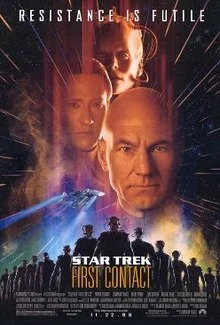
220px-Star_trek_first_contact_poster.jpg

Star Trek: First Contact (1996)

Mac Boyle July 4, 2019

Director: Jonathan Frakes

Cast*: Patrick Stewart, Brent Spiner, James Cromwell**, Alfre Woodard

Have I Seen it Before: Oh, yes… I have the most vivd memory of coming out of the theater in November 1996 getting picked up by my parents. When they asked me how it was, I said, “The greatest two hours*** of my life.” They said, “You’re young yet.” Nearly twenty-five years later, I’m still not entirely sure what they were talking about.

Did I Like It: See the above comment.

At their core, the four films based on The Next Generation are a mixed bag. The producers behind the various television series of the era maybe never quite got out of their television mindset, so one could argue that we just got four feature-length new episodes featuring an A-plot for Picard (Stewart) and a B-plot for Data (Spiner). The rest of the cast—the main draw for that section of the audience that was likely to buy multiple tickets—got a few pieces of business here and there.

But in 1996—the thirtieth anniversary of the franchise—all of the cylinders were firing, and thus, we were treated to Picard and company’s undisputedly greatest film. Like The Wrath of Khan (1982) before it, First Contact wisely mines one of the better television entries and makes a more epic sequel, while at the same time not vapidly mimicking the structure of that earlier, GOAT movie, like they did in the near-unwatchable Nemesis (2002). There are also plenty of references to Moby Dick.

And still, my opinion of the film has morphed considerably over the years. As I have with most Trek films, I walked out of the theater thinking it was perfect. I’ve been wrong every time. For years afterward, I came to think Picard’s plot on the starship exacting his revenge on the Borg was the real story, while the prepping of the flight of the Phoenix down on Earth was filler. I now think of Picard’s Ahab-ing as mostly fine, if a little redundant of action star schtick which feels ill-fitting for Stewart. The real genius of the film is with Cochrane (Cromwell).

He’s a lout. A drinker. A low-level sex maniac. He has a passing interest in his work and legacy, but only in how much it will keep him in the company of his vices.

By most honest accounts, Gene Roddenberry—the creator of Star Trek—was the same way. Producer Rick Berman stated that the idea behind the film was to do something about the creation of Star Trek (i.e., the first meeting of Vulcan and Human, and the introduction of FTL flight).

He wasn’t kidding. This movie is about the genesis of the notion of Star Trek, and at the helm of this great idea is a creator history would lionize, but who was just as imperfect as the rest of us.


*It’s one of the near-fatal flaws of the Next Generation films that they never quite found enough for the rest of the cast—especially the funnier-than-she-gets-credit-for Gates McFadden—to do in their four entries into the canon.

**So I’m sitting at my computer, and for the life of me my mind is blanking on the actor who played the father of warp drive. It eventually came to me, but it has to be a testament to the actor that I don’t think of his name or any of the other numerous roles he’s played. He simply is Zefram Cochrane. Which is all the more impressive as legend has it the first choice for the role was none other than admitted Star Trek mega fan Tom Hanks, but he sadly had to back out as he was focused on directing That Thing You Do (1996). He would have been great, too, but here we are.

***The runtime is 111 minutes, but I’m sure the trailers were top-notch.

Tags star trek first contact (1996), jonathan frakes, patrick stewart, brent spiner, james cromwell, alfre woodard, star trek film series
Comment
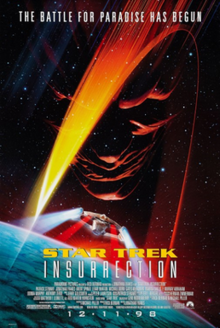
220px-Star_Trek_Insurrection.png

Star Trek: Insurrection (1998)

Mac Boyle January 5, 2019

Director: Jonathan Frakes

Cast: Patrick Stewart, Brent Spiner, Jonathan Frakes, F. Murray Abraham

Have I Seen it Before: Over twenty years ago, I opted out a date with my first girlfriend to ensure I saw this one opening weekend. So yeah.

Did I Like It: How many new episodes of Star Trek: The Next Generation are we likely to get? Don’t answer that question just yet… Picard is coming back…

The text of this review appeared previously in a blog post entitled “How Could No One Else Like These Movies? Part Two, But With No Electric Boogaloo.” published 04/30/2017.

I’m not sure why the ninth film in the series—the fourth to feature The Next Generation crew—gets shit on so much. This is especially true when the series also includes the two-plus hour sleeping pill that is The Motion Picture (1979), the sloppy ode to mountain climbing that is The Final Frontier (1989)*, and that testament to uninspired mediocrity that was Nemesis (2002).

The most frequent complaint I hear about this movie is that, after the epic battle across time and space in First Contact (1996)**, this follow-up is less an actual movie, and more a very basic, episode of the television series upon which it is based. To that, I ask: Why is that a problem? If anyone reading this has ever taken in any random episode of The Next Generation*** and not enjoyed it, then, maybe your problem with Insurrection is that you just don’t like Star Trek that much.

The ancillary material for the film is even better. The late Michael Piller wrote a no-holds-barred account of his experiences writing the screenplay. It’s one of the truly great screenwriting books, ranking right up there with William Goldman’s Adventures in the Screen Trade. It’s only recently available, and I can’t recommend it highly enough.


*Which I actually kind of like, and almost made its way onto this list, except that I get that the movie doesn’t work for the most part. 

**I realize now that movies may have began and ended for me in 1996.

***First season being the only exception, naturally.

Tags star trek insurrection (1998), jonathan frakes, patrick stewart, brent spiner, f murray abraham
Comment

Powered by Squarespace

Party Now, Apocalypse Later Industries

Where creativity went when it said it was going out for cigarettes.

Where creativity went when it said it was going out for cigarettes.