
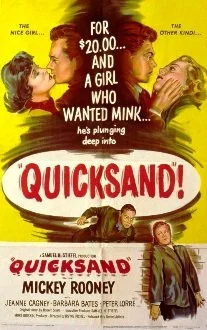
Director: Irving Pichel
Cast: Mickey Rooney, Jeanne Cagney, Barbara Bates, Peter Lorre
Have I Seen it Before: Never.
Did I Like It: For the longest stretch of its runtime, Quicksand begins to resemble the platonic ideal of film noir. A man (Rooney) has eyes on a blonde (Cagney) that any reasonable person would decide is more trouble than she’s worth. One seemingly harmless scheme feeds into a series of increasingly complex and risky schemes, until eventually every cop in town is looking for the man, and the net slowly shrinks until there’s no other possible ending than something violent, tragic, and vaguely akin to poetic justice.
But then there’s that last act. I’m resolutely a non-fan of noir—or thrillers in general—allowing its characters to walk away from their escalating problems* as the number one way for me to feel cheated by the proceedings. Fargo (1996)—that pinnacle of the post-modern noir—wouldn’t have let William H. Macy just tell everybody what his scheme was before the woodchipper met Steve Buscemi. And so, I don’t think Rooney should have gotten off light here.
Even that I could forgive, if the near-miss at the end of the character’s story flows naturally from the plot that precedes it. No such luck here, unfortunately. Everything gets tied up in a nice, neat bow because our hero’s last fit of fleeing takes the form of carjacking someone who just happens to be a skilled and experienced criminal attorney. He explains that it’s somewhat less than a guarantee that Rooney’s victim actually died in the attack**, and that if he makes good with the police now, he may only have to go away for a few years, after which he can move on to a happy life with the brunette he was clearly supposed to be with from the beginning.
And—after a brief shootout—that’s exactly what Rooney does. Yawn.
*Yes, I would count getting a few years prison sentence and barely missing a murder charge or a watery grave as walking away from problems.
**I’ll admit enjoying that small revelation, as I’m always bothered by the efficiency of death in these movies, when it seems like the human body is at least slightly more resilient than expiring immediately after getting the wind knocked out of it.