Party Now, Apocalypse Later Industries

Where creativity went when it said it was going out for cigarettes.
  • Home
  • BOOKS
    • THE ONCE AND FUTURE ORSON WELLES
    • IF ANY OF THESE STORIES GOES OVER 1000 WORDS...
    • ORSON WELLES OF MARS
    • THE DEVIL LIVES IN BEVERLY HILLS
    • A LOSS FOR NORMALCY
    • RIGHT - A NOVEL OF POLITICS
  • PODCASTS
    • Beyond the Cabin in the Woods
    • THE HOLODECK IS BROKEN
    • THE FOURTH WALL
    • As The Myth Turns
    • FRIENDIBALS! - TWO FRIENDS TALKING ABOUT HANNIBAL LECTER
    • DISORGANIZED! A Criminal Minds Podcast
  • MOVIE REVIEWS
  • BLOGS AND MORE
    • Bloggy B Bloggington III, DDS
    • THE HOLODECK IS BROKEN BLOG
    • REALLY GOOD MAN!
  • Home
    • THE ONCE AND FUTURE ORSON WELLES
    • IF ANY OF THESE STORIES GOES OVER 1000 WORDS...
    • ORSON WELLES OF MARS
    • THE DEVIL LIVES IN BEVERLY HILLS
    • A LOSS FOR NORMALCY
    • RIGHT - A NOVEL OF POLITICS
    • Beyond the Cabin in the Woods
    • THE HOLODECK IS BROKEN
    • THE FOURTH WALL
    • As The Myth Turns
    • FRIENDIBALS! - TWO FRIENDS TALKING ABOUT HANNIBAL LECTER
    • DISORGANIZED! A Criminal Minds Podcast
  • MOVIE REVIEWS
    • Bloggy B Bloggington III, DDS
    • THE HOLODECK IS BROKEN BLOG
    • REALLY GOOD MAN!

A Blog About Watching Movies (AKA a Blog in Search of a Better Title)

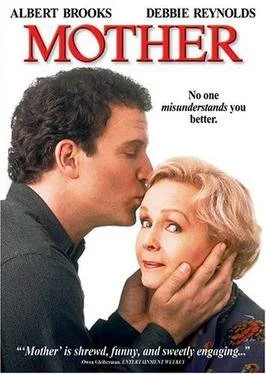
Mother (1996)

Mac Boyle November 28, 2025

Director: Albert Brooks

Cast: Albert Brooks, Debbie Reynolds, Rob Morrow, Lisa Kudrow

Have I Seen It Before: Yes. I remember this film eerily well. I honestly think it aired on HBO, I recorded it, and I watched it over and over again.

Did I Like It: It’s odd to say that Brooks—and specifically Brooks’ character in this film—was something of an heroic figure for my adolescence. He made a living writing science fiction books. I wanted* to make a living at writing science fiction novels. What’s more, I wanted to just happen upon beautiful women out in public who are so windswept by my typing that she’s willing to follow me to what would be to any rational observer a meetup for serial killers, and that would solve all of my lovelorn problems.

Forget the fact that he has a painfully neurotic relationship—matched only by his brother (Morrow)—with his mother, is irretrievably blocked** on his next novel, and that he has been twice divorced. John Henderson had the life.

And he fixes his relationship with his mother (Reynolds)! What more could a man want out of life when he gets to his forties?

The humor of the film is lively, making conscious decisions at every point to not descend into sitcom cliché and make every beat not only emanate from the characters as we’ve come to know them, but be in service of the characters ongoing development. It’s an exceptionally, almost deceptively well-crafted comedy. So much so that by the resolution, there might be a flash of feeling cheated, but not everything has to end with one more punchline.

And if you think it was easy for me to admit that, you’re crazy.

The casting is also quite good. Brooks plays the same leading-man he has created for himself previously, but does it without any trace of a self-consciousness that you might come to expect from writer-director-stars. Look out for Lisa Kudrow’s near-cameo. I think we all get how good she really is, but opting to be “the blind date” in an Albert Brooks’ movie is a more purely comedic choice for an actress at that point in her career, when she could have just as easily been the second half of any cookie cutter romantic comedy, and made plenty of money in the effort.

Then there’s Debbie Reynolds. Picking up her career after several years away, she’s as natural as she was in decades past. It’s infinitely fascinating that Nancy Reagan (of all people) seriously considered playing the part before ultimately passing. She wouldn’t have been nearly as good—and indeed, never was—as Reynolds, but my, oh my, would that have been a fascinating version of this film.

*I haven’t given up the ghost on it, but… You know. I live in the real world.

**I get the need to introduce complications into the life of a main character, but blocks are for chumps. Throw him Grady Tripp’s (Michael Douglas) problems in Wonder Boys (2000) and then we have something.
Tags mother (1996), albert brooks, debbie reynolds, rob morrow, lisa kudrow
Comment

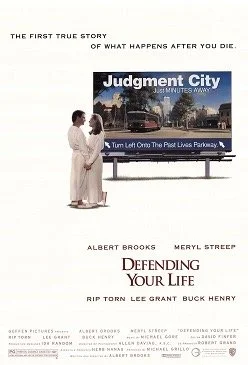
Defending Your Life (1991)

Mac Boyle June 4, 2022

Director: Albert Brooks

Cast: Albert Brooks, Meryl Streep, Rip Torn, Lee Grant

Have I Seen it Before: Yep, but it’s been so many years and I watched it a time when I was watching everything I get my hands on that the memory of it has likely faded somewhat.

Did I Like It: There’s not a lot discussion I’ve seen as to just how much this film influenced the sublime experience that became Michael Schur’s The Good Place, but the relationship between ancestor and descendant is certainly there, and I doubt that there is higher praise I can give to either endeavor than that.

Whereas that later work widened the lens to present as perfect a speculative comedic novel in visual form as we’re likely to ever get, this film takes a particular focus on the subject matter and manages to make a Woody Allen-esque* out of the raw material. That would be enough to highly recommend the film, but there’s something so deeply affecting about—of all things—the film’s underlying theology.

Utilitarian good and bad are concepts so difficult to define—to say nothing of enforce—that they threatened to unravel all of existence in The Good Place. In Defending Your Life, intentions behind actions are the governing principle. Was the good or bad done on Earth coming out of fear or love? What’s more, there is no damnation for a botched attempt on the first go around. You’ll move on when you’re ready, or you might not, but that would only come with an insistence to not improve. This may be the only grander design for the nature of the universe that can lay claim to any degree of benevolence and still account for the deeply heinous among us dumb 3-percenters.

I may be a bit of a Brooks-ist at my core.

*Which is the only way I can take in his particular brand of comedy these days without it adding a serious black mark to my own eventual assessment in Judgment City.

Tags defending your life (1991), albert brooks, meryl streep, rip torn, lee grantr
Comment
220px-Taxi_driver_movieposter.jpg

Taxi Driver (1976)

Mac Boyle October 29, 2019

Director: Martin Scorsese

Cast: Robert De Niro, Jodie Foster, Cybil Shepard, Albert Brooks

Have I Seen It Before?: Never. They’re coming to take my official film snob membership card as I type this.

Did I like it?: It’s an experience, but I’d have to be a certain kind of person (read: Hinckley) to say I really enjoyed it.

The movie is such an insistent attempt to make a film that eschews the usual trappings of Hollywood entertainment, but Bernard Hermann’s score (his last, he passed away before the wide release of the film) bubbles through the movie. If you were only listening to the proceedings instead of watching, you’d be forgiven for thinking it was a romantic comedy in the early goings. Between that and the whole cowboy motif and homages to The Searchers (1956) it’s hard not to see this movie as the story of a man—and perhaps a culture at large—warped by exposure to cowboy stories that never fully came to grips with the violence that surrounds them.

And then there’s that ending. 

I’m so constantly annoyed by the rash of youtube videos “explaining” the ending of like, every film released. They’re boring bordering on odious. I don’t need an explanation of Joker (2019). It’s pretty straight ahead, if wobbly. For that matter, why would anyone need the ending of a movie like Spider-Man: Far From Home (2019) explained. Most—if not all—current movies are as straight ahead in their proceedings as your basic fairy tale.

But I digress. I’ll be damned if at the end of this movie I didn’t want to rush to the internet and have the true nature of our final moments with Bickle spoon-fed to me. Thankfully—blissfully, even—there is no concrete answer. Both Scorsese and screenwriter Paul Schrader acknowledge the interpretation that after Bickle guns down the gangsters, synapses fire in his mind for the last time and he imagines a world where he ended up a hero, but maintain that their intension was to display the irony of a monster like their main character slipping into a hero’s role purely by luck, with the knowledge that he will be nowhere near that lucky the next time. I like that version of the ending better; it inflames the imagination.

Tags taxi driver (1976), robert de niro, martin scorsese, jodie foster, cybill shepherd, albert brooks
Comment

Powered by Squarespace

Party Now, Apocalypse Later Industries

Where creativity went when it said it was going out for cigarettes.

Where creativity went when it said it was going out for cigarettes.