I’m a big fan of The Twilight Zone. I’m such a big fan of the show that I’ve been known to suggest fisticuffs whenever the honor of Rod Serling is impugned*. “To Serve Man,” “Nightmare at 20,000 Feet”, “Time Enough at Last”. These are truly great episodes of television.
And yet, efforts to re-capture the magic of the original TV show have often floundered. Sure Zone inspired a pinball machine that is the absolute pinnacle of that art form, but both attempts to bring the television series back—in 1985 and 2002—are less than memorable. Maybe the advent of color removed all magic from the concept**.
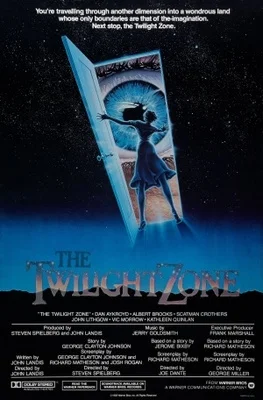
When the movie powerhouse of Steven Spielberg and John Landis attempted to make an anthology film based on the series, the reaction to the film was equally tepid.
In some cases obliquely, and in others much more directly, Twilight Zone: The Movie (1983) offers remakes of four classic episodes of the TV series to varying degrees of effectiveness, and for that matter, sheer horror.
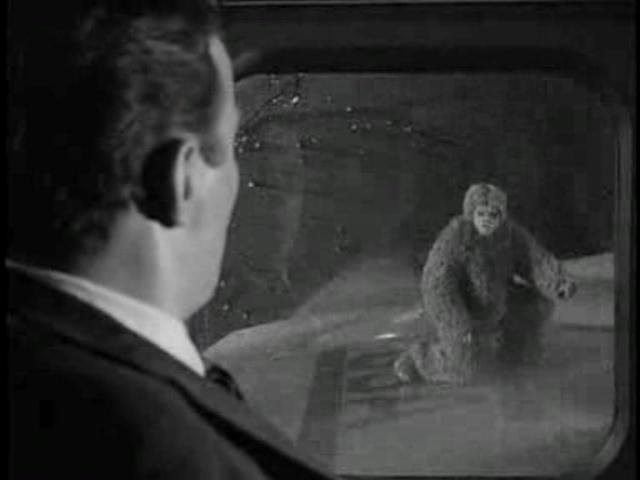
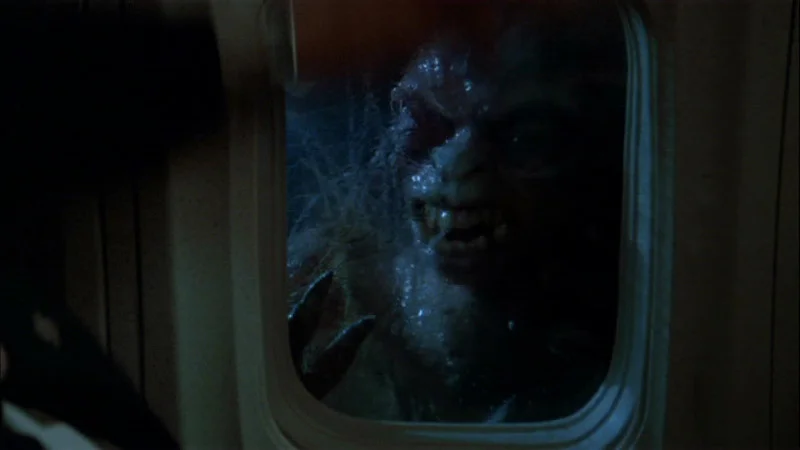
The strongest segment among them is the last: a manic, claustrophobic redux of the Richard Matheson classic “Nightmare at 20,000 Feet” with John Lithgow as a naturally neurotic replacement for William Shatner. The gremlin on the wing of the plane in this version is far less laughable than the demented Lamb Chop of the original episode, and is more a terrifying, self-aware wraith ready to set up a homestead in your nightmares.
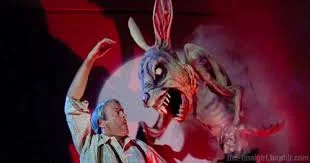
Moving backwards both in chronology and quality, Kathleen Quinlan stars in a re-constructed “It’s a Good Life”, the tale of a young boy with nigh-omnipotent powers and the destruction he leaves in his wake. Joe Dante (Gremlins, Innerspace) brings his penchant for cartoonish malevolence to bear here, but it is an aptitude that doesn’t come to full fruition until Gremlins 2: The New Batch (1990). The ending Dante and company choose for the tale—wherein the kindly school teacher (Quinlan) tries to temper the god-boy’s misanthropy—falls short of the ending that appears in the original episode and skews a little too close to the happy-happy Spielbergian ideal so prevalent in the 80s.
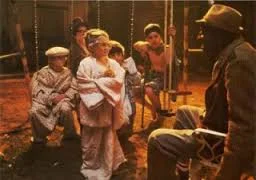
Which makes sense, given that Spielberg’s own entry for the film is such a concentrated package of pathos that it almost warrants a dosage of Humalog packaged with every DVD. Scatman Crothers gives a group of residents at an old folks home the opportunity to reclaim their childhood, quite literally. It’s precious. And that’s all fine. Spielberg’s gonna Spielberg, especially pre-The Color Purple (1985), but you should at least be prepared.
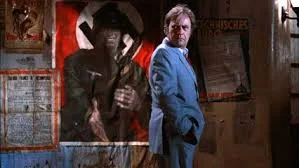
And then there’s director John Landis’ (Animal House, The Blues Brothers) opening entry in the movie. It’s the least conceptually sound of all four stories. One imagines that this is because it has the least to do with one of the original TV episodes. Bill Connor (Vic Morrow) is an unrepentant racist and basket case who finds himself tumbling through time. With each Quantum Leap like jump, he finds himself as a different oppressed minority. At the end, he watches his friends shrug through his disappearance as he is taken away to a concentration camp in Nazi-era Europe.
It’s kind of a muddled mess, although it does have the virtue of having the classic hopeless-turn-as-moral ending that made the TV series famous. There is a reason both for its messiness and its bleak ending. It’s more horrifying than any moment in the finished film, I assure you.
I made reference to the incident in <last week’s blog>, but in the early hours of July 23, 1982, on the final night of filming for the segment, an accident occurred that took the lives of three actors.
Accounts vary, but these are the generally accepted facts. The final shooting involved a massive sequence that would find Morrow’s character saving two Vietnamese children from a village under attack by American helicopters, after which he would be redeemed and return to his life reformed after only a half-hour or so of trauma.
With a helicopter hovering nearby and explosions igniting all around them, Morrow crawls out into a small lake with a child in each arm. One of the pyrotechnic explosions caused the rear rotor on the helicopter to fail. The craft spun out of control and crashed into the nearby lake. The pilot and other crew members on board the chopper survived with minor injuries. On the ground, the helicopter decapitated Morrow and one of the child actors, 7-year-old Myca Dinh Le, and crushed the other child actor, 6-year-old Renee Shin-yi Chen. Rolling cameras from at least three different angles caught the whole sequence of events. The internet has archived this footage for all time, because of course it has. Several industrious online editors have even managed to enhance the footage frame-by-frame, because of course they have. I don’t recommend seeking out the footage for yourself. Just… Trust me.
Under “normal” circumstances, this would be a horrifying tragedy, but it gets worse from there. Some insist that Landis—in complete disregard of any semblance of safety—tried to order the lethal helicopter to an altitude even lower than the already dangerous 25 feet it maintained above the ground. Landis denies this, and instead points to the error of a special effects technician and a mis-timed explosion as the sole causes for the accident. The producers and director further disregarded safety and labor laws in a number of other ways. Child actors weren’t supposed to work in such close proximity to that degree of pyrotechnics; the filmmakers did anyway. Child actors weren’t supposed to work at such a late hour; the filmmakers paid their parents under the table. Landis copped to this much but, again, insists to this day that those factors had nothing to do with the actual accident.
NTSB inquiries labeled the event an accident, although they significantly changed their rules regulating helicopters on film sets. Civil cases took several years to settle with the families, while Landis and four other crew members were placed on trial for manslaughter. Amid some degree of controversy in the pre-OJ world, the five were acquitted of any criminal wrongdoing.
Even if I accept Landis’ side of the story and that every moment of the incident was beyond any reasonable control, I can’t imagine having blood on my hands for one of my own silly projects, regardless of how it turned out. Maybe it’s a shocking, potentially overwhelming story, but whenever I think about the Twilight Zone movie and the accident that accompanied it, I try to find some object lesson in the events. Maybe it’s that being creative is great, but being a human being is probably far more important.
*Don’t believe me? I issued just such a challenge on Friday. Twice. I will defend Mr. Serling’s honor, so help me Krom.
**To be fair, I think conversion away from black and white not only diminished attempts at remaking the Zone, but television, film, photography, and the entirety of human civilization. I’m willing to admit I might be alone there.