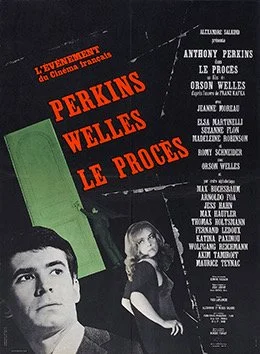
Director: Orson Welles
Cast: Anthony Perkins, Orson Welles, Jeanne Moreau, Romy Schneider
Have I Seen it Before: Never. Hey, some of them have slipped under the radar, and when it comes to a director like Welles, the further on you get in the filmography, the less the DVD/Blu Ray releases are shown love, and the less we may be getting out of the film all together.
Did I Like It: Welles once called it his best movie. We can debate as to whether or not he really believed that, or if he was making the proclamation defensively, whether because of the muted response the film received originally, or whether he was so desperate to move public opinion away from Citizen Kane (1941).
I think he had to be defensive about it all. To be certain, all of the scenes have that trademark Welles vitality that is only truly noticeable when the contrasting authors of The Magnificent Ambersons (1942) are experienced. Camera angles are arch, people talk over people (unheard of, even this late in Welles career) and everything moves with a vitality that proves once again Welles was never content to just let a scene play out in the manner in which any other, ordinary and mortal director would be content.
Here’s the thing, though. The “pinscreen” opening might have had some unusual quality in the time it was released, but here it feels like a powerpoint presentation masquerading as cinema. I grant that might be more about the time in which I am writing this review than the reality of the quality of the film itself, but I can’t write these words in another time. The beginning becomes a further albatross because it suggests that the entire film is meant to be a dream. I’m not sure if that actually is Welles’ intent or not, but it would certainly explain the films more impressionistic impulses, but then we are left with a question that is unavoidable:
How long can a film sustain itself if it is all meant to be a dream? Do we dream sustained for two hours? Does my current era lack the attention span to allow for a dream that goes on that long? The film certainly has more interest in questions than answers, but if I’m spending the entire time asking the wrong questions, am I the problem, or is it the film?